


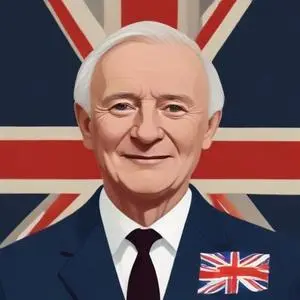
A pioneering physicist who split the atomic nucleus, unlocking the secrets of nuclear energy and paving the way for groundbreaking discoveries.
John Cockcroft is renowned for being the first to split the atomic nucleus, a groundbreaking feat that earned him the Nobel Prize in Physics in 1951, alongside Ernest Walton. This monumental achievement marked a significant milestone in the history of nuclear physics, paving the way for the development of nuclear power.
Born on May 27, 1897, in Todmorden, England, Cockcroft's fascination with science was evident from an early age. He studied electrical engineering at Manchester Municipal College of Technology while working as an apprentice at Metropolitan Vickers Trafford Park. His exceptional skills earned him a scholarship to St. John's College, Cambridge, where he excelled in the tripos exam in 1924, becoming a wrangler.
Under the guidance of the illustrious Ernest Rutherford, Cockcroft pursued his doctorate at the Cavendish Laboratory, completing it in 1928. It was during this period that he collaborated with Ernest Walton and Mark Oliphant to build the Cockcroft-Walton generator. This innovative device enabled them to achieve the first artificial disintegration of an atomic nucleus, a feat that would change the face of nuclear physics forever.
During World War II, Cockcroft played a crucial role in the development of radar technology, serving as the Assistant Director of Scientific Research in the Ministry of Supply. He was also a key member of the MAUD Committee, which explored the feasibility of creating an atomic bomb. In 1940, he was part of the Tizard Mission, which shared British radar technology with the United States. This exchange would eventually yield significant benefits for Britain, including the SCR584 radar set and the proximity fuze, instrumental in defeating the V1 flying bomb.
In May 1944, Cockcroft became the director of the Montreal Laboratory, where he oversaw the development of the ZEEP and NRX reactors, as well as the establishment of the Chalk River Laboratories. His leadership and expertise were instrumental in the growth of nuclear research in Canada.
After the war, Cockcroft returned to England to become the director of the Atomic Energy Research Establishment (AERE) at Harwell. During his tenure, he played a vital role in shaping the UK's nuclear energy policy and guiding the development of nuclear power.
In recognition of his pioneering work, Cockcroft was awarded the Nobel Prize in Physics in 1951, alongside Ernest Walton. He was also knighted in 1948 for his services to science. Today, Cockcroft's legacy continues to inspire generations of scientists, and his groundbreaking contributions to nuclear physics remain a testament to his innovative spirit and dedication to the advancement of human knowledge.
Cockcroft's remarkable life and achievements serve as a powerful reminder of the importance of scientific curiosity, innovation, and collaboration. His work has left an indelible mark on the world of nuclear physics, and his legacy continues to inspire and educate future generations of scientists and thinkers.
Born in 1871
A pioneer in nuclear physics, he discovered the nucleus of an atom and developed the Rutherford model, revolutionizing our understanding of the atomic structure.
Born in 1885
A pioneer in quantum mechanics, he introduced the concept of wave-particle duality, revolutionizing our understanding of atomic structure. His philosophical approach to science also explored the nature of reality and human understanding.
Born in 1901
A pioneer in quantum mechanics, he formulated the uncertainty principle, which revolutionized our understanding of the atomic world. His groundbreaking work reshaped modern physics.
Born in 1901
A pioneer in nuclear physics, known for leading the team that developed the first nuclear reactor and playing a crucial role in the development of the atomic bomb.
Born in 1898
A pioneer in nuclear physics, known for conceiving the idea of a nuclear chain reaction and patenting the concept of a nuclear reactor. He also played a key role in persuading Einstein to warn Roosevelt about the possibility of Germany developing an atomic bomb.
Born in 1879
A pioneering nuclear chemist who discovered nuclear fission, a process that releases massive energy from atomic nuclei, and was awarded the Nobel Prize in Chemistry in 1944.
Born in 1878
Pioneering physicist who made groundbreaking contributions to nuclear physics, including the discovery of nuclear fission, and was the first woman to become a full professor of physics in Germany.
Born in 1900
A Nobel Prize-winning physicist who pioneered radioactivity research and discovered artificial radioactivity, leading to breakthroughs in medicine and industry.
