


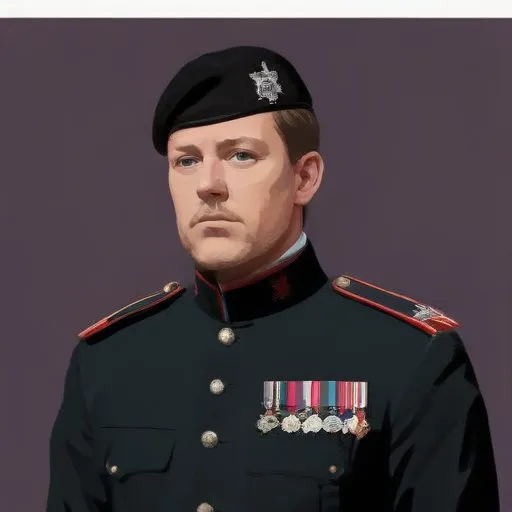
A Scottish lieutenant and banker who received the Victoria Cross for his bravery during the Indian Rebellion of 1857, known for his heroic actions during the Siege of Lucknow.
John Alexander Cruickshank, a Scottish former banker and Royal Air Force officer, is none other than the last living recipient of the Victoria Cross, the highest award for gallantry in the face of the enemy that can be awarded to British and Commonwealth forces, during the Second World War. He received this prestigious honor for his heroic act of sinking a German U-boat and then, despite serious injuries, safely landing his aircraft.
Cruickshank was born on 20 May 1920 in Aberdeen, Scotland, and educated at the Royal High School, Edinburgh, Aberdeen Grammar School, and Daniel Stewarts College. He started his career as an apprentice to the Commercial Bank in Edinburgh, but soon joined the Territorial Army in May 1939, following his father's suggestion.
After serving in the Royal Artillery for a year, Cruickshank transferred to the Royal Air Force Volunteer Reserve in the summer of 1941. He underwent flight training in Canada and the United States, earning his wings in July 1942. He received an emergency commission as a pilot officer in the RAFVR and was promoted to flying officer warsubstantive on 10 January 1943.
On 17 July 1944, Cruickshank piloted a Consolidated Catalina antisubmarine flying boat from Sullom Voe in Shetland, as part of No. 210 Squadron of RAF Coastal Command. The objective was to protect the British Home Fleet as it returned from the unsuccessful Operation Mascot raid on the German battleship Tirpitz. During the patrol, Cruickshank's aircraft detected and attacked a German U-boat, U-361, in the Norwegian Sea.
Despite being seriously injured in the attack, Cruickshank managed to safely land his aircraft, saving the lives of his crew. This act of bravery and selflessness earned him the Victoria Cross, which was gazetted on 1 September 1944.
After the war, Cruickshank returned to his banking career, eventually becoming a manager at the Commercial Bank of Scotland. He remained humble about his heroic act, and it wasn't until much later in life that he began to share his story with the public.
Cruickshank's legacy extends beyond his bravery during the war. He has inspired generations of Scots and Britons, and his story has been an embodiment of courage and selflessness. Today, he remains the last living recipient of the Victoria Cross from the Second World War, a testament to his heroism and the ultimate sacrifice made by so many during the war.
Cruickshank's story serves as a reminder of the bravery and sacrifice of those who served during the Second World War, and his legacy continues to inspire generations to come.
Born in 1910
A British Royal Air Force flying ace during World War II, known for his bravery and flying skills despite having two prosthetic legs. He was a symbol of inspiration and determination.
Born in 1871
Prolific writer of historical novels and adventure stories, also a talented landscape painter.
Born in 1891
A renowned World War II military strategist, known for leading the Afrika Korps and earning the respect of both allies and enemies with his tactical genius.
Born in 1865
The second monarch of the House of Windsor, reigning from 1910 to 1936, known for leading the British Empire through World War I and modernizing the monarchy.
Born in 1884
A British field marshal who played a crucial role in World War II, particularly in North Africa and the Middle East, and is remembered for his leadership and strategic decisions during the war.
