


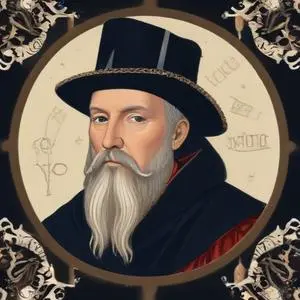
A 16th-century polymath who made significant contributions to mathematics, astronomy, and navigation, and was also a consultant to Queen Elizabeth I on astrological and mystical matters.
John Dee, the renowned English mathematician, astronomer, and occultist, is best known for his role as the court astronomer and advisor to Queen Elizabeth I, as well as his obsession with alchemy, divination, and Hermetic philosophy. His life's work, marked by a thirst for knowledge and a passion for the unknown, has left an indelible mark on the realms of mathematics, astronomy, and the occult.
Born on July 13, 1527, in Tower Ward, London, to Rowland Dee and Johanna Wild, John Dee's early life was marked by a strong connection to his Welsh heritage. His father, a mercer and gentleman courtier to Henry VIII, instilled in him a love for learning, which would shape his future.
Dee attended Chelmsford Chantry School (now King Edward VI Grammar School) from 1535 to 1542, before entering St John's College, Cambridge, in 1542. He graduated with a BA in 1545 or early 1546, and his exceptional abilities earned him a fellowship at Trinity College, Cambridge, upon its foundation by Henry VIII in 1546.
Dee's expertise in mathematics, astronomy, and navigation caught the attention of Queen Elizabeth I, who appointed him as her court astronomer and advisor. He played a pivotal role in promoting the establishment of English colonies in the New World, coining the term "British Empire" in the process.
During his time in the Queen's service, Dee amassed one of the largest libraries in England, comprising over 2,500 books and manuscripts. His vast collection included works on alchemy, astrology, and Hermetic philosophy, reflecting his deep fascination with the mysteries of the universe.
Dee's obsession with the occult and supernatural eventually led him to leave the Queen's service and embark on a journey to uncover hidden knowledge. He aligned himself with various individuals, including the notorious Edward Kelley, and traveled extensively throughout Europe, seeking out ancient wisdom and forbidden knowledge.
Accusations of spying for the English crown and charlatanism marred Dee's reputation, and upon his return to England, he found his home and library vandalized. Despite this, he continued to seek the Queen's favor, but was ultimately turned away when James I succeeded Elizabeth I.
John Dee's later life was marked by poverty and obscurity. He died in 1608 or 1609, and his gravesite remains unknown. Despite the controversy surrounding his life, Dee's contributions to mathematics, astronomy, and the occult have left a lasting impact on modern society.
His legacy extends beyond the realm of science and philosophy, influencing literature and art, with authors such as William Butler Yeats and Aleister Crowley drawing inspiration from his work. Today, John Dee remains an enigmatic figure, a true Renaissance man whose pursuit of knowledge and wisdom continues to captivate and inspire.
John Dee's life and work must be understood within the context of the Renaissance, a time of great cultural, scientific, and philosophical transformation. His contributions to mathematics, astronomy, and the occult reflected the era's fascination with ancient wisdom and the pursuit of knowledge.
Today, Dee's legacy continues to influence modern society, from literature and art to science and philosophy. His work serves as a testament to the power of human curiosity and the boundless potential of the human mind.
Born in 1564
Renowned playwright and poet behind iconic works like Romeo and Juliet, Hamlet, and Macbeth, whose writings continue to influence literature and theater to this day.
Born in 1561
A 16th-17th century Renaissance figure who pioneered the scientific method and empiricism, and served as a prominent government official.
Born in 1577
A 17th-century polymath who wrote extensively on melancholy, anatomy, and literature, producing influential works that shaped the Renaissance era's understanding of human emotions and the natural world.
Born in 1546
A 16th-century astronomer who made precise measurements of the stars and planets, laying the foundation for modern astronomy. His data helped Kepler discover planetary orbits.
Born in 1473
A Renaissance-era mathematician and astronomer who proposed the heliocentric model, where the Sun is at the center of our solar system, revolutionizing our understanding of the universe.
Born in 1564
Pioneering astronomer, physicist, and mathematician who played a major role in the Scientific Revolution, making key discoveries that challenged Aristotelian views and laid the foundation for modern science.
Born in 1571
A 17th-century trailblazer who discovered the three laws of planetary motion, revolutionizing our understanding of the solar system. He's also credited with being a pioneer in the field of astrology.
Born in 1564
A Renaissance master of words, crafting plays and poems that explored the human condition, and translating ancient texts into English, leaving a lasting impact on literature.
