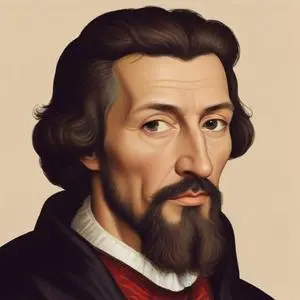
John Donne: The Metaphysical Maestro
A Poetic Genius Ahead of His Time
John Donne is renowned for his ingenious mastery of metaphysical conceits, which has earned him the title of the preeminent representative of the metaphysical poets. His poetic works are a testament to his innovative style, characterized by abrupt openings, paradoxes, ironies, and dislocations, which set him apart from his contemporaries.
Life of a Renaissance Man
Born in 1571 or 1572 in London, Donne was part of a recusant Roman Catholic family, a faith that was illegal in England at the time. Despite the challenges, he went on to lead a life that was as fascinating as it was tumultuous.
Early Years and Education
Donne's early years were marked by a thirst for knowledge, which led him to pursue his education at Hart Hall, Oxford, and later at Lincoln's Inn, London. His studies were cut short due to his Catholic faith, which made it impossible for him to take the Oath of Supremacy.
From Soldier to Cleric
In 1596, Donne embarked on a military expedition to Cadiz with
Robert Devereux, 2nd Earl of Essex. Upon his return, he found himself in a precarious financial situation, relying heavily on the patronage of wealthy friends. It wasn't until 1615 that he was ordained as an Anglican deacon and then priest, although he was initially reluctant to take holy orders.
Poetic Masterpieces
Donne's poetry is a reflection of his experiences, intellectual pursuits, and spiritual struggles. His works include sonnets, love poems, religious poems, Latin translations, epigrams, elegies, songs, and satires. Some of his most famous poems include "The Sun Rising," "The Flea," and "A Valediction: Forbidding Mourning."
Metaphysical Conceits and Style
Donne's poetic style is characterized by its use of metaphysical conceits, which are extended metaphors that compare two things that are seemingly unrelated. This style, which was novel for its time, has been praised for its ability to convey complex ideas and emotions in a unique and powerful way.
Influence on Modern Society
Donne's poetry has had a profound influence on modern literature, with many poets and writers drawing inspiration from his work. His innovations in language, style, and form have paved the way for future generations of poets.
Personal Life and Controversies
Donne's personal life was marked by controversy, including his secret marriage to Anne More in 1601, with whom he had twelve children. He was also known for his womanizing and extravagant spending habits, which often left him in financial straits.
Lasting Legacy
John Donne's legacy extends far beyond his poetry. He was a cleric, a politician, and a philosopher, whose contributions to the English language and literature are still felt today. As Dean of St. Paul's Cathedral in London from 1621 until his death in 1631, he played a significant role in shaping the Church of England.
Quotes and Memorable Sayings
- "No man is an island, entire of itself; every man is a piece of the continent, a part of the main."
- "Death be not proud, though some have called thee mighty and dreadful, thou art not so."
Remembering John Donne
John Donne's life was a testament to his boundless energy, creativity, and intellectual curiosity. As we reflect on his life and works, we are reminded of the power of poetry to transcend time and touch the human experience.
FAQ
Who was John Donne and what were his contributions to English literature?
John Donne was an English poet, satirist, and cleric who made significant contributions to English literature, known for his metaphysical poetry, complex imagery, and exploration of themes such as love, death, and spirituality.
What were John Donnes most famous works of poetry?
John Donnes most famous works of poetry include his Holy Sonnets, which explore themes of spirituality, mortality, and the nature of God, and his metaphysical poems, which showcase his complex imagery and intellectual rigor.
How did John Donnes experiences as a cleric influence his poetry?
John Donnes experiences as a cleric significantly influenced his poetry, providing him with a deep understanding of spirituality, theology, and the human condition, which he explored in his poetry.
What was John Donnes role in the development of the Metaphysical school of poetry?
John Donne was a leading figure in the development of the Metaphysical school of poetry, a group of poets known for their complex imagery, intellectual rigor, and exploration of themes such as love, death, and spirituality.
What is John Donnes legacy in modern English literature?
John Donnes legacy in modern English literature is that of a master poet and thinker who helped shape the development of the Metaphysical school, and whose poetry continues to be admired and studied today for its complexity, depth, and beauty.