


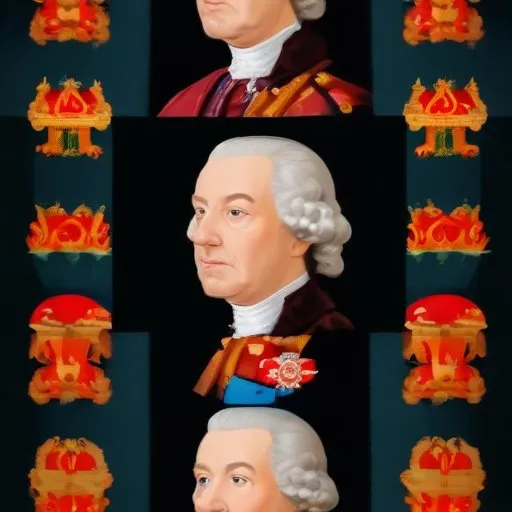
Elector of Saxony from 1656 to 1680, known for his cultural and artistic achievements, particularly in architecture and music. He commissioned many notable buildings and composers, enriching Saxony's cultural landscape.
John George II, Elector of Saxony, is renowned for his profound passion for music and art, transforming Dresden into the cultural hub of Germany during his reign from 1656 to 1680. As a patron of the arts, he welcomed foreign musicians and artists, fostering a vibrant cultural scene that continues to inspire to this day.
Born on May 31, 1613, John George II was the third but eldest surviving son of John George I, Elector of Saxony, and Magdalene Sibylle of Prussia. He succeeded his father as Elector of Saxony in 1656, marks the beginning of his remarkable cultural legacy.
Unlike his contemporaries, John George II's primary interests lay not in politics, but in music and art. He entered into friendly relations with Louis XIV, accepting financial assistance from the French king. However, his allegiance remained with the Emperor Leopold I, as he navigated the complex web of alliances during his reign.
John George II's love for music knew no bounds. He commissioned the construction of the first opera house, the Opernhaus am Taschenberg, which became a beacon of cultural excellence in Dresden. This magnificent building was the epicenter of musical performances, hosting some of the most renowned musicians of the time.
In 1658, John George II was inducted into the Fruitbearing Society, a prestigious literary and artistic organization, through the patronage of Duke William of Saxe-Weimar. This affiliation further solidified his reputation as a champion of the arts, attracting artists and intellectuals from across Europe.
John George II's reign saw the gradual economic reconstruction of Saxony after the devastating Thirty Years' War. He encouraged the development of new trades and manufactures, such as textiles, hard coal, and glass. The Leipzig Trade Fair and the Bohemian Exulanten of 1654 also stimulated economic activity, replenishing the elector's treasury with locally mined silver.
John George II's passing on August 22, 1680, in Freiberg, marked the end of an era. His cultural legacy, however, continues to inspire generations. Dresden, once a mere city, was transformed into a hub of artistic excellence, earning its reputation as the "Florence on the Elbe."
John George II's remarkable life serves as a testament to the transformative power of art and culture. His unwavering dedication to the arts has left an indelible mark on Dresden, ensuring his legacy as one of the most celebrated patrons of the arts in German history.
Born in 1526
A 16th-century German ruler who played a key role in the Protestant Reformation and was a strong supporter of the arts, commissioning many notable works of literature and music.
Born in 1483
A German monk and priest who sparked the Protestant Reformation, challenging Catholic Church authority and shaping Western Christianity. He's famous for nailing 95 theses to a church door, sparking a religious revolution.
Born in 1497
A 16th-century Renaissance scholar who made significant contributions to the development of the Protestant Reformation and education, known for his theological writings and astronomical observations.
Born in 1485
A key figure in the Protestant Reformation, he played a crucial role in shaping Lutheran theology and was a close advisor to Martin Luther. He's also known for his work in establishing the Lutheran Church in Denmark and Norway.
Born in 1493
A 16th-century Lutheran reformer and theologian who played a key role in shaping the Protestant Reformation, particularly in Germany. He's known for his translations of Luther's works and his own theological writings.
