


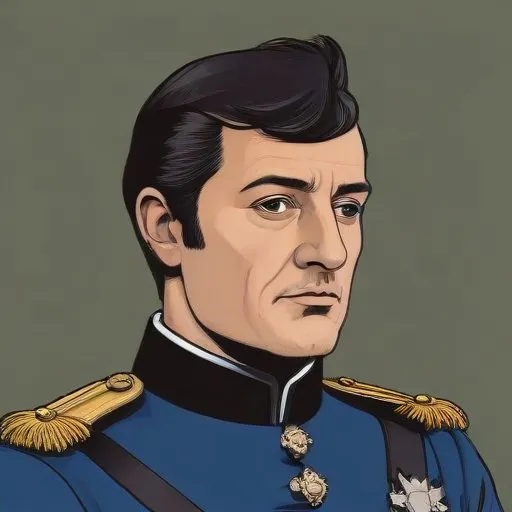
A Scottish general who led the Jacobite rising of 1689, known for his bravery and military tactics in the Battle of Killiecrankie. He fought for the restoration of the Stuart dynasty to the British throne.
John Graham, 1st Viscount Dundee, is remembered as the leader of the Jacobite rising of 1689, a valiant general who rallied the Highland clans loyalty to King James VII of Scotland, ultimately giving his life for the cause. His bravery in the Battle of Killiecrankie earned him the coveted title of "Bonnie Dundee", cementing his place in Scottish history as a champion of the Jacobite cause.
Born around 1648, John Graham was the elder son of Sir William Graham and Lady Madeline Carnegie, from a junior branch of the Graham family that had acquired the estate of Claverhouse near Dundee. He had two sisters and was educated with his younger brother David at the University of St Andrews, graduating in 1661.
Following his father's death around 1652, John and David became wards of their uncles and other relatives. In 1660, they were listed as burgesses of Dundee, by reason of their father's privilege, and John Graham inherited the Claverhouse estate when he came of age in the summer of 1669. His maternal uncle, David Carnegie, Lord Lour, secured him an appointment as a Commissioner of Excise and Justice of the Peace for Angus in 1669.
Graham's military career began during the Franco-Dutch War in 1672, where he honed his skills as a soldier. Upon his return, he continued to serve the Scottish government, policing southwest Scotland during and after the religious unrest and rebellion of the late 17th century.
In 1689, Graham rallied the Highland clans loyal to the Jacobite cause, leading them in the battle against the government forces. Despite being outnumbered, Graham's forces emerged victorious at Killiecrankie, earning him the admiration of his troops and the Scottish people. Though the rising ultimately failed, Graham's bravery and leadership secured his place in Scottish history.
John Graham, 1st Viscount Dundee, died on July 27, 1689, but his legacy lives on. His bravery and loyalty to the Jacobite cause have made him a Scottish hero, and his name is still revered today. His story serves as a reminder of the complexities of Scottish history and the enduring spirit of those who fought for their beliefs.
Graham's story has inspired countless works of literature, art, and music, cementing his place in popular culture. His legacy serves as a testament to the power of conviction and the enduring spirit of those who dare to challenge the status quo.
Born in 1658
Scottish general who led military campaigns to suppress the Jacobite risings and served as Lord High Commissioner to the Scottish Parliament, known for his role in shaping Scotland's history.
Born in 1616
A 17th-century Scottish politician who served as Secretary of State for Scotland, known for his role in restoring the Scottish Episcopacy and his influence on the country's government during the Restoration period.
Born in 1666
Scottish field marshal who led military campaigns in the 17th century, earning a noble title for his victories. He played a significant role in the Wars of the Three Kingdoms.
Born in 1649
Leader of the Monmouth Rebellion, a failed attempt to overthrow King James II of England, and known for his charismatic military leadership.
Born in 1650
A renowned military strategist and politician who led British forces to numerous victories in the War of the Spanish Succession, earning him great acclaim and prestige. He was also a trusted advisor to Queen Anne.
Born in 1274
Led Scotland during the First War of Scottish Independence, ultimately securing a decisive victory at the Battle of Bannockburn and earning recognition as the country's rightful king. He's celebrated for his bravery, strategic thinking, and unwavering commitment to Scottish freedom.
Born in 1599
Leader of the Parliamentarian forces during the English Civil War, who later ruled England, Scotland, and Ireland as a republican dictator, known for his military victories and radical reforms.
