


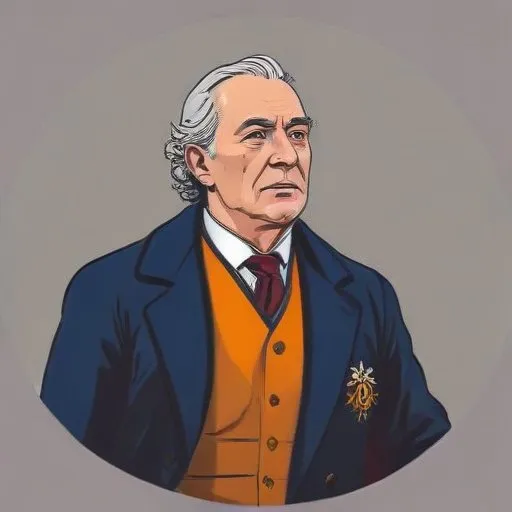
A 17th-century Scottish politician who served as Secretary of State for Scotland, known for his role in restoring the Scottish Episcopacy and his influence on the country's government during the Restoration period.
John Maitland, 1st Duke of Lauderdale, was a Scottish politician who rose to prominence as a leader within the influential Cabal Ministry during the 17th century. He is renowned for his tumultuous career, which oscillated between zealous support for the Presbyterian cause and unwavering loyalty to King Charles I, earning him a reputation as a shrewd and cunning statesman.
Born on May 24, 1616, John Maitland was the eldest surviving son of John Maitland, 2nd Lord Maitland of Thirlestane, and Lady Isabel Seton. He descended from an ancient family with roots in Berwickshire and East Lothian. His great-grandfather, Sir Richard Maitland of Lethington, was a poet, leaving an indelible mark on the family's cultural heritage.
In 1643, Maitland took the Covenant, solidifying his commitment to the Presbyterian cause. He attended the General Assembly of the Church of Scotland in St Andrews and was subsequently sent to England as a Commissioner for the Covenant. Later, in November, he participated in the Westminster Assembly, where he worked tirelessly to persuade the English Parliament to adopt Presbyterianism.
In February 1644, Maitland's influence extended to both England and Scotland, as he became a member of the Privy Councils of both kingdoms. He played a crucial role in the negotiations between the Scottish Estates and King Charles I, attempting to broker a deal that would establish Presbyterianism in England.
However, in 1647, Maitland's allegiance shifted dramatically when he began to support King Charles I's restoration. He engaged in secret negotiations with the monarch, even obtaining the famous Engagement at Carisbrooke Castle, which promised to establish Presbyterianism in England for three years in exchange for Scottish military aid.
John Maitland, 1st Duke of Lauderdale's, tumultuous career left an indelible mark on the complex tapestry of 17th-century British politics. His ability to navigate the treacherous waters of factional politics, coupled with his cunning and adaptability, earned him a reputation as a master strategist. While his legacy remains shrouded in controversy, his influence on the development of the Cabal Ministry and his role in shaping the course of British history cannot be overstated.
| 1616 | John Maitland, 1st Duke of Lauderdale, is born. |
| 1643 | Maitland takes the Covenant, solidifying his commitment to the Presbyterian cause. |
| 1644 | Maitland becomes a member of the Privy Councils of both England and Scotland. |
| 1647 | Maitland obtains the Engagement at Carisbrooke Castle, promising to establish Presbyterianism in England. |
| 1682 | John Maitland, 1st Duke of Lauderdale, passes away. |
John Maitland, 1st Duke of Lauderdale's, life and career serve as a microcosm of the tumultuous 17th century, a time of great upheaval and transformation in British politics and society. His legacy, while complex and multifaceted, remains an integral part of the rich tapestry of British history, offering valuable insights into the intricacies of power, politics, and the human condition.
Born in 1599
Leader of the Parliamentarian forces during the English Civil War, who later ruled England, Scotland, and Ireland as a republican dictator, known for his military victories and radical reforms.
Born in 1630
The last monarch of the House of Stuart, restored to the throne after a republican Commonwealth, known for his lavish spending, mistresses, and the Great Fire of London. He ruled with a mix of absolutism and indulgence, shaping England's Restoration era.
Born in 1633
The last Catholic monarch of England, Scotland, and Ireland, who attempted to restore Catholicism and absolute monarchy, sparking the Glorious Revolution. He's infamous for his authoritarian rule and religious intolerance.
Born in 1759
Celebrated for his poignant and lyrical poetry, he penned iconic works that capture the essence of Scottish culture and identity. His contributions to literature continue to inspire and delight readers worldwide.
Born in 1771
A renowned author of historical novels, plays, and poetry, credited with creating the genre of historical fiction and influencing the development of the novel as a literary form.
61 Years Old
A lawyer and politician who served in the U.S. House of Representatives from 1987 to 1997, known for his moderate Republican views and advocacy for environmental issues.
Born in 1711
A Scottish Enlightenment thinker who developed influential ideas on morality, ethics, and human nature, and is considered one of the most important figures in the history of Western philosophy.
Born in 1632
A 17th-century thinker who laid the groundwork for modern democracy, arguing that governments derive their power from the people and that individuals have inherent rights to life, liberty, and property.
