


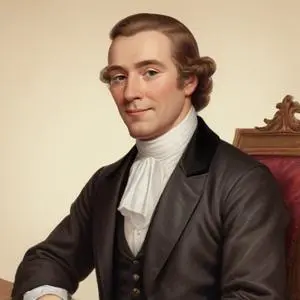
Pioneering demographer and statistician who analyzed London's mortality rates, creating the first life table and laying the foundation for modern epidemiology and data analysis.
John Graunt, a 17th-century English statistician and epidemiologist, is widely regarded as the founder of demography, revolutionizing the field with his groundbreaking work on human statistical analysis and census methods. His pioneering spirit and innovative approach to data analysis led to the development of life tables, which provided probabilities of survival to each age, thereby laying the foundation for modern demography.
Born on April 24, 1620, in London, England, John Graunt was the eldest of seven or eight children to Henry and Mary Graunt. His father, a draper from Hampshire, instilled in him a strong sense of commerce and mathematics. Graunt's early life was marked by his apprenticeship in his father's shop, where he developed a keen eye for numbers and statistics.
In 1641, Graunt married Mary Scott, with whom he had four children. He became a freeman of the Drapers Company at the age of 21, solidifying his position in the city's commercial circles. As his father's shop flourished, Graunt's analytical mind began to wander, and he started to explore the world of statistics and demography.
Graunt's magnum opus, Natural and Political Observations Made Upon the Bills of Mortality, published in 1662, catapulted him to fame in the scientific community. This seminal work introduced the concept of life tables, which provided a framework for understanding mortality rates and population growth. Graunt's innovative approach to data analysis and his ability to extract insights from raw data made him a pioneer in the field.
Graunt's work had a profound impact on the development of demography, epidemiology, and public health. His life tables enabled governments and policymakers to make informed decisions about population growth, resource allocation, and healthcare. His work also inspired future generations of demographers, including Edmond Halley, who built upon Graunt's ideas to develop the first actuarial tables.
In recognition of his contributions, Graunt was elected a Fellow of the Royal Society in 1662, with the endorsement of King Charles II. This prestigious honor marked the culmination of his life's work and solidified his position as a pioneer in the field of demography.
Graunt faced personal challenges, including bankruptcy triggered by losses suffered during the Great Fire of London and discrimination following his conversion to Catholicism. Despite these setbacks, he continued to work tirelessly, making significant contributions to the field of demography.
John Graunt's work has had a lasting impact on modern society, influencing the development of census methods, public health policies, and population growth strategies. His legacy extends beyond the realm of demography, inspiring future generations of statisticians, epidemiologists, and policymakers.
John Graunt's remarkable life and work left an indelible mark on the field of demography, epidemiology, and public health. His pioneering spirit, innovative approach to data analysis, and groundbreaking contributions to the field have inspired generations of scholars and policymakers. Today, Graunt is remembered as a true pioneer, whose work continues to influence modern society and shape our understanding of population growth and public health.
Born in 1656
Predicted celestial events, including the return of a comet that bears his name, and made significant contributions to navigation, astronomy, and mathematics.
Born in 1627
Pioneering scientist who discovered Boyle's Law, which describes the relationship between pressure and volume of gases, and laid foundations for modern chemistry.
Born in 1623
Developed the concept of gross national product (GNP) and is considered the father of modern economics, making significant contributions to the field of economics.
Born in 1876
American rower who won a gold medal at the 1920 Summer Olympics and set multiple world records in the sport. Known for his exceptional rowing technique and dominance in the sport during the 1920s.
Born in 1800
A renowned poet, historian, and politician who played a significant role in shaping British politics and literature in the 19th century, particularly through his writings on British history. He's also known for his influential essays and speeches that reflected his liberal and reformist views.
