


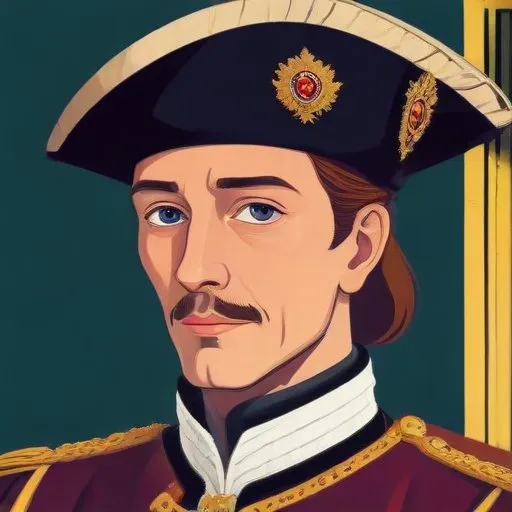
A Dutch nobleman who served as a Stadtholder of Holland, Zeeland, and Utrecht, and played a key role in the Dutch Revolt against Spanish rule. He's known for his military victories and diplomatic skills.
John III of Egmont, also known as Egmond Hattem, was a prominent figure in the late 15th century, celebrated for his esteemed position as Stadtholder of Holland, Zeeland, and WestFriesland. His unwavering loyalty to the Burgundian dynasty and his pivotal role in the Hook and Cod wars cemented his legacy as a skilled politician and military leader.
Born on April 3, 1438, in Egmond, John was the son of William II of Egmont and Walburga van Meurs. He was raised in a family deeply committed to the Burgundian cause, and his father's influence shaped his early life and career. In 1465, John embarked on a pilgrimage to the Holy Land, where he was inducted into the esteemed Knights of the Holy Sepulchre, demonstrating his deep devotion to his faith.
When Charles the Bold rose to power in Guelders, John's loyalty and military prowess earned him the appointment as bailiff of WestFriesland and governor of Arnhem in 1474. His subsequent involvement in the Hook and Cod wars solidified his position as a trusted ally of the Burgundian dynasty. In 1483, Maximilian of Austria rewarded John's unwavering support by appointing him Stadtholder of Holland, Zeeland, and WestFriesland, a title he held until 1515.
In recognition of his distinguished service, John was inducted into the Order of the Golden Fleece, one of the most prestigious chivalric orders in Europe. His marriage to Magdalena van Werdenburg in 1484 produced 10 children, including Walburga, who would become the first wife of William I, Count of Nassau-Siegen, and George, who would go on to become Bishop of Utrecht.
Portraits of John III of Egmont are preserved in the Rijksmuseum Amsterdam, the Centraal Museum of Utrecht, and the Metropolitan Museum of Art in New York, a testament to his enduring legacy. The diptych painted by the Master of Alkmaar, now housed in the Metropolitan Museum of Art, serves as a poignant reminder of his cultural significance.
John III of Egmont's remarkable life is a testament to his unwavering loyalty, military prowess, and cultural significance. As Stadtholder of Holland, Zeeland, and WestFriesland, he played a pivotal role in shaping the course of European history, leaving behind a legacy that continues to inspire and fascinate to this day.
Born in 1500
Ruling over a vast empire from 1519 to 1556, he was a powerful and influential leader who played a crucial role in shaping European politics and religion. He is most known for his efforts to unify Christian Europe and defend it against the Ottoman Empire.
Born in 1380
Unified the Crown of Aragon, ruling over a vast territory in eastern Spain, and sponsored the voyages of Christopher Columbus, leading to the discovery of the New World.
Born in 1451
Unified the Spanish kingdoms, sponsored Christopher Columbus's voyage to the Americas, and established the Spanish Inquisition.
Born in 1457
Sovereign Duchess regnant of Burgundy, married to Maximilian I, Holy Roman Emperor, who ruled Burgundy and played a crucial role in shaping European politics and history through her marriage and alliances. She's also known for her cultural and artistic patronage.
Born in 1433
The last Valois Duke of Burgundy, he unified the Burgundian territories and fought to create a kingdom, leaving a legacy of cultural and economic achievements. His ambitions and military campaigns shaped European politics and history.
Born in 1459
First Holy Roman Emperor to rule simultaneously as King of the Romans and King of Spain, known for uniting fragmented German states and establishing the Habsburg dynasty.
