


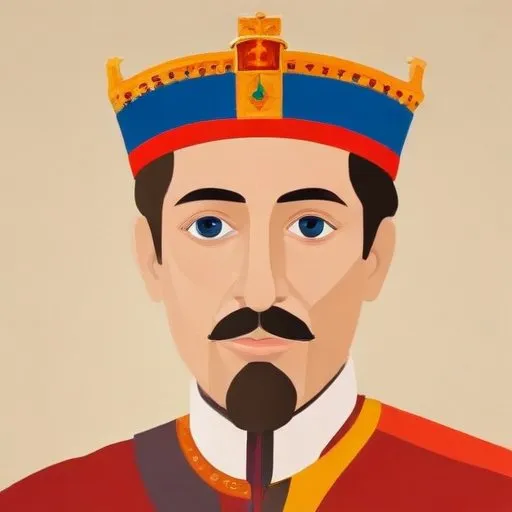
Restored Portuguese independence from Spain, establishing the House of Braganza and becoming the first king of Portugal's new dynasty. He's also known for his cultural and artistic patronage.
John IV, also known as John the Restorer, is renowned for his pivotal role in restoring Portugal's independence from Habsburg Spanish rule, marking the end of the 60-year-old Iberian Union. His accession to the throne in 1640 established the House of Braganza as the ruling dynasty of Portugal, cementing his place in history as a champion of Portuguese sovereignty.
Born on 19 March 1604, in Vila Viçosa, John IV was the grandson of Catherine, Duchess of Braganza, a claimant to the Portuguese throne during the succession crisis of 1580. He succeeded his father, Teodósio II, as the 8th Duke of Braganza in 1630, following the latter's death due to insanity.
The catalyst for John IV's rise to power was the death of Philip II of Portugal (III of Spain), which led to the succession of Philip III (IV of Spain). The latter's policies, including increased taxes on Portuguese merchants and the erosion of Portuguese noble influence, sparked widespread discontent among the nobility and bourgeoisie. This discontent culminated in a revolution on 1 December 1640, sixty years after Philip II of Spain's accession to the Portuguese throne.
The Forty Conspirators, a group of nobles and bourgeoisie, orchestrated the plot to overthrow the Spanish-dominated government. They assassinated the Secretary of State, Miguel de Vasconcelos, and imprisoned Margaret of Savoy, the king's cousin. John IV, then the Duke of Braganza, was proclaimed King of Portugal, marking the beginning of the Portuguese restoration of independence.
John IV's reign was marked by several significant achievements, including:
John IV was married to Luisa de Guzmán, the eldest daughter of Juan Manuel Pérez de Guzmán, 8th Duke of Medina Sidonia, in 1633. He was described as having blonde hair and an average height.
On the eve of his death in 1656, the Portuguese Empire was at its territorial zenith, spanning the globe. John IV's legacy as the Restorer of Independence has endured, earning him a revered place in Portuguese history.
His reign marked a turning point in Portuguese history, as the country began to assert its independence and establish itself as a major player on the global stage. John IV's courage, vision, and leadership paved the way for Portugal's future growth and prosperity, making him one of the most significant figures in Portuguese history.
Born in 1554
The last monarch of the House of Aviz, who disappeared during a crusade in Morocco, leading to a succession crisis that changed the course of Portuguese history. He's a legendary figure, symbolizing a lost golden age.
Born in 1394
A Portuguese prince who sponsored and organized numerous expeditions to explore and map the west coast of Africa, leading to the discovery of new trade routes and territories. He played a crucial role in the Age of Exploration.
Born in 1451
Unified the Spanish kingdoms, sponsored Christopher Columbus's voyage to the Americas, and established the Spanish Inquisition.
Born in 1469
King of Portugal from 1495 to 1521, known for sponsoring Vasco da Gama's voyage to India, establishing trade routes, and promoting the Portuguese Renaissance.
Born in 1455
King of Portugal from 1481 to 1495, known for his centralizing policies, establishing a strong monarchy, and sponsoring explorers like Bartolomeu Dias and Vasco da Gama.
Born in 1554
The last monarch of the House of Aviz, who disappeared during a crusade in Morocco, leading to a succession crisis that changed the course of Portuguese history. He's a legendary figure, symbolizing a lost golden age.
Born in 1432
King of Portugal who ruled from 1438 to 1481, known for his military conquests in North Africa and the expansion of Portuguese trade and exploration.
