


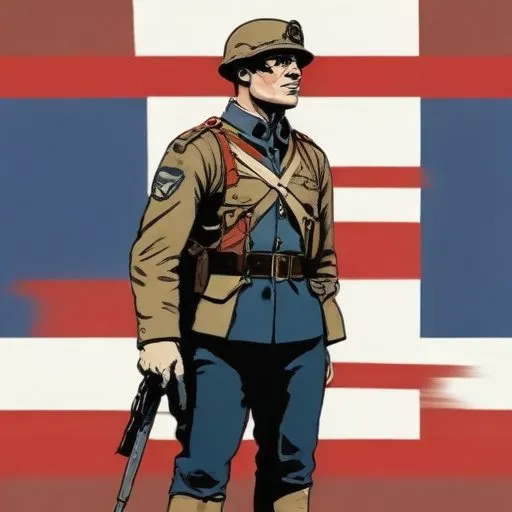
A French-American soldier who served in the American Civil War and later became a lawyer, known for his efforts to reform the US military's treatment of prisoners of war.
John Ordronaux was one of the most successful privateers of the War of 1812, commanding two ships, Marengo and Prince de Neufchatel, and capturing or destroying about thirty British merchant ships. His daring exploits at sea and cunning evasions of British warships earned him a reputation as a master of the high seas.
Born on December 16, 1778, in Nantes, Brittany, France, Ordronaux was the son of a French merchant skipper, John Ordronaux senior, and an English mother, Joanna Hammond from Hull, England. His mixed heritage and upbringing would later influence his skills as a privateer, navigating the complex waters of Franco-American relations during the War of 1812.
In 1811, Ordronaux's patron, a wealthy French lady named Florye Charretton, outfitted the privateer Marengo in New York City. Ordronaux took command of the ship in June 1812, just as the War of 1812 broke out. With Marengo, he captured several British ships, including the Lady Sherbroke, Eliza, and Lady Provost. His success drew the attention of the British Navy, and he was pursued by the 36-gun frigate HMS Belvidera. However, Ordronaux outmaneuvered his pursuers, thanks in part to the intervention of the USS President and its squadron, commanded by Captain John Rodgers.
Later in the war, Ordronaux took command of the Prince de Neufchatel, a larger and more powerful ship. With this vessel, he continued to harass British merchant ships, capturing or destroying many more. His exploits earned him a reputation as a cunning and elusive privateer, respected by his enemies and revered by his countrymen.
In August 1812, Ordronaux captured a young Scotsman named James Swanston Miller from the English ship Concord. In a surprising move, Ordronaux stranded Miller on the island of Grand Canary, where he would go on to build a mercantile dynasty that would boost the local economy for generations to come. This chance encounter had far-reaching consequences, as the Swanston and Miller families would go on to play a significant role in the development of the island's economy.
John Ordronaux's daring exploits during the War of 1812 cemented his place as one of the most successful privateers in American history. His cunning and bravery at sea earned him a reputation as a master of the high seas, and his legacy continues to inspire and fascinate to this day. Ordronaux's impact extended beyond the battlefield, as his actions helped to disrupt British trade and commerce, contributing to the ultimate American victory in the war.
Born in 1763
French admiral who commanded the combined French and Spanish fleet during the Napoleonic Wars, ultimately defeated at the Battle of Trafalgar in 1805.
Born in 1769
A skilled military strategist and one of Napoleon's most trusted generals, known for his bravery and tactical genius on the battlefield.
Born in 1767
A flamboyant and daring cavalry commander who played a key role in Napoleon's military conquests, earning the title of King of Naples.
Born in 1758
A skilled military strategist and one of Napoleon's most trusted generals, known for his victories in the Peninsular War and his role in shaping modern warfare.
Born in 1769
A skilled and fearless military leader, known for his bravery and tactical genius on the battlefield, particularly during the Napoleonic Wars.
Born in 1770
A renowned military strategist and statesman who played a crucial role in Napoleon's conquests and later became a key figure in French politics, known for his exceptional organizational skills and bravery.
