


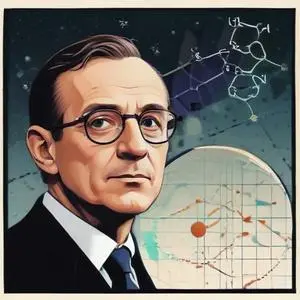
Developed computational methods in quantum chemistry, enabling accurate predictions of molecular properties and reactions. This work revolutionized the field of chemistry and has had a lasting impact on our understanding of molecular interactions.
Renowned British theoretical chemist Sir John Pople is best known for his groundbreaking contributions to the development of computational methods in quantum chemistry, earning him the Nobel Prize in Chemistry in 1998, alongside Walter Kohn. His pioneering work has had a profound impact on the field, transforming the way scientists approach complex chemical problems.
Born on October 31, 1925, in Burnham-on-Sea, Somerset, Pople's academic excellence earned him a scholarship to Trinity College, Cambridge, in 1943. He received his Bachelor of Arts degree in 1946 and subsequently worked at the Bristol Aeroplane Company between 1945 and 1947. Returning to the University of Cambridge, he was awarded his PhD in mathematics in 1951, focusing on lone pair electrons under the supervision of John Lennard-Jones.
Pople's remarkable career spanned multiple institutions, including Trinity College, Cambridge, the National Physical Laboratory, and Carnegie Mellon University. His research focus was divided into four key areas:
In addition to the Nobel Prize in Chemistry, Pople received several prestigious awards, including:
Sir John Pople's remarkable legacy extends beyond his scientific contributions. He was a dedicated educator, supervising numerous PhD students throughout his career. Pople's influence on modern society is evident in the widespread application of his computational methods in fields such as materials science, pharmacology, and biotechnology.
Did you know that Sir John Pople considered himself more of a mathematician than a chemist? Despite this, he is widely regarded as one of the most important theoretical chemists of his time.
Sir John Pople passed away on March 15, 2004, leaving behind a legacy of groundbreaking research and a profound impact on the field of quantum chemistry.
Born in 1896
Developed the molecular orbital method, a fundamental concept in chemistry that explains the structure and behavior of molecules. He was awarded the Nobel Prize in Chemistry in 1966 for his work.
Born in 1901
Pioneering chemist and peace activist who won two unshared Nobel Prizes, one for chemistry and one for peace, for his groundbreaking work on the nature of the chemical bond and his tireless efforts to promote nuclear disarmament.
89 Years Old
A Nobel Prize-winning chemist who pioneered the field of organic chemistry and introduced the concept of orbital symmetry, revolutionizing our understanding of chemical reactions.
Born in 1918
A Japanese chemist and academic who won the Nobel Prize for his work on chemical reactions, particularly in the field of orbital symmetry. He developed the Fukui function, a concept used to understand chemical reactivity.
Born in 1918
Organic chemist and Nobel laureate who developed a new way to synthesize complex molecules, revolutionizing the field of chemistry. His work led to the creation of new medicines and materials.
Born in 1897
A Norwegian chemist and academic who pioneered the study of molecular structure, particularly the three-dimensional shape of molecules, and was awarded the Nobel Prize in Chemistry in 1969.
Born in 1897
Developed the Wittig reaction, a groundbreaking method for forming carbon-carbon double bonds, revolutionizing organic chemistry. This discovery enabled the creation of complex molecules with unprecedented precision.
