


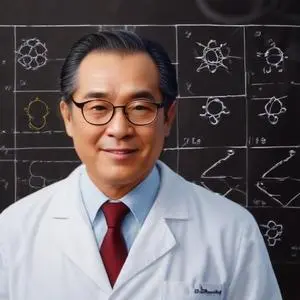
A Japanese chemist and academic who won the Nobel Prize for his work on chemical reactions, particularly in the field of orbital symmetry. He developed the Fukui function, a concept used to understand chemical reactivity.
Kenichi Fukui, a Japanese chemist, made history in 1981 by becoming the first person of East Asian ancestry to receive the Nobel Prize in Chemistry. He shared the prestigious award with Roald Hoffmann for their groundbreaking work on the mechanisms of chemical reactions, particularly the role of frontier orbitals.
Born on October 4, 1918, in Nara, Japan, Fukui was the eldest of three sons to Ryokichi Fukui, a foreign trade merchant, and Chie Fukui. During his student days between 1938 and 1941, Fukui's interest in quantum mechanics and Erwin Schrödinger's equation was sparked. He also developed a belief that scientific breakthroughs often occur through the unexpected fusion of remotely related fields.
Fukui's path to chemistry was not a straightforward one. In an interview, he recalled that chemistry was not his favorite subject in middle school and high school. However, the influence of his respected teacher, Fabre, and the advice of Professor Genitsu Kita of the Kyoto Imperial University, led him to pursue a career in chemistry.
Fukui's Nobel Prize-winning work focused on the role of frontier orbitals in chemical reactions. He proposed that molecules share loosely bonded electrons, which occupy the Highest Occupied Molecular Orbital (HOMO) and the Lowest Unoccupied Molecular Orbital (LUMO). This theory revolutionized the understanding of chemical reactions and had significant implications for fields such as organic chemistry and materials science.
Fukui's work was not only driven by scientific curiosity but also by his philosophical beliefs. He believed that scientific breakthroughs often occur through the fusion of remotely related fields and that creativity is essential in scientific research. He also emphasized the importance of understanding the fundamental principles of science rather than just memorizing formulas and equations.
Fukui's work has had a significant impact on modern society. His theory of frontier orbitals has led to the development of new materials and technologies, including advanced ceramics and semiconductors. His work has also inspired new generations of scientists and chemists, promoting international collaboration and advancing scientific knowledge.
Fukui's life was marked by simplicity and humility. He was married to Tomoe Horie, and they had two daughters together. Fukui passed away on January 9, 1998, but his legacy continues to inspire scientists and chemists around the world.
Through his groundbreaking work and philosophical contributions, Kenichi Fukui has left an indelible mark on the world of chemistry and beyond.
89 Years Old
A Nobel Prize-winning chemist who pioneered the field of organic chemistry and introduced the concept of orbital symmetry, revolutionizing our understanding of chemical reactions.
Born in 1912
Developed groundbreaking methods for synthesizing and using boranes, a class of compounds crucial in organic chemistry, earning the Nobel Prize in Chemistry in 1979.
Born in 1897
Developed the Wittig reaction, a groundbreaking method for forming carbon-carbon double bonds, revolutionizing organic chemistry. This discovery enabled the creation of complex molecules with unprecedented precision.
Born in 1918
Organic chemist and Nobel laureate who developed a new way to synthesize complex molecules, revolutionizing the field of chemistry. His work led to the creation of new medicines and materials.
Born in 1906
A Croatian-Swiss chemist and academic who pioneered research in organic chemistry, particularly in the field of stereochemistry, and was awarded the Nobel Prize in Chemistry in 1975.
Born in 1917
Pioneering organic chemist who synthesized complex natural products and developed new methods, earning a Nobel Prize in Chemistry. His work revolutionized the field of organic chemistry.
Born in 1923
A Nobel Prize-winning chemist and academic who developed the theory of electron transfer, a fundamental concept in chemistry, and made significant contributions to our understanding of chemical reactions.
