


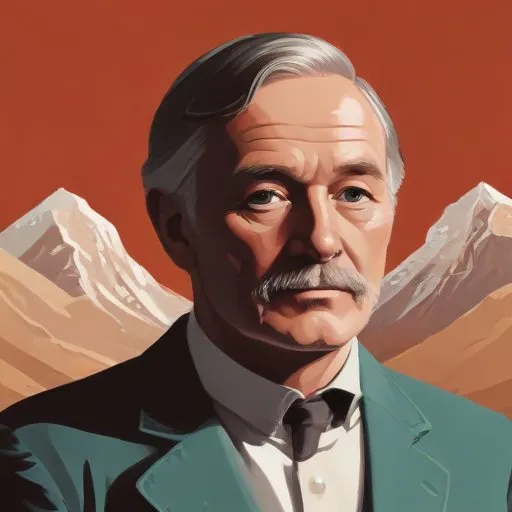
A prominent 19th-century geologist and academic who made significant contributions to the field of geology, particularly in the study of Canadian fossils and the formation of the Earth's crust.
John William Dawson is renowned for his groundbreaking contributions to the field of geology, particularly in the discovery of ancient fossil forests and the unearthing of prehistoric reptiles. As a prolific educator, he revolutionized the Canadian education system, introducing innovative reforms and designing iconic schoolhouses that still stand today.
Born on October 13, 1820, in Pictou, Nova Scotia, Dawson was of Scottish descent. He attended the University of Edinburgh, where he graduated in 1842 with a strong foundation in geology and natural history under the guidance of Robert Jameson.
In 1850, Dawson returned to Nova Scotia and was appointed as the province's first superintendent of education, a position he held until 1853. During this tenure, he championed educational reforms, introducing novel ideas on school design, teacher education, and curriculum development. Influenced by American educator Henry Barnard, Dawson published a pamphlet on School Architecture, which remains a testament to his progressive vision.
One of the many schools built according to his design is the Mount Hanley Schoolhouse, which still stands today, featuring the iconic "Dawson Desks" that bear his name. As superintendent, Dawson's travels allowed him to deepen his geological studies, leading to the publication of his seminal work, Acadian Geology, in 1855.
Dawson's geological explorations took him to the cliffs of Joggins, Nova Scotia, where he discovered the fossil remains of ancient trees, now a UNESCO World Heritage Site. Alongside Charles Lyell, he unearthed the remains of a tetrapod, Dendrerpeton, entombed within a fossil tree in 1852. This groundbreaking find paved the way for his subsequent discovery of the oldest known reptile, Hylonomus lyelli, named in honor of his mentor.
From 1855 to 1893, Dawson served as professor of geology and principal of McGill University in Montreal, elevating the institution to a position of prominence during his tenure. His influence extended beyond the realm of geology, as he passionately advocated for education reform, teacher training, and the promotion of scientific inquiry.
Dawson's legacy extends far beyond his academic achievements. His work continues to inspire generations of geologists, educators, and thinkers. Today, his name is synonymous with excellence in education and geological exploration, a testament to his unwavering dedication to the pursuit of knowledge.
John William Dawson's remarkable life and achievements serve as a beacon of inspiration, reminding us of the power of human curiosity and the importance of education in shaping our understanding of the world.
Born in 1797
A Scottish geologist who pioneered the concept of uniformitarianism, which states that the Earth's geological features were shaped by slow, gradual processes over millions of years. His work laid the foundation for modern geology and influenced Charles Darwin's theory of evolution.
Born in 1785
Founded the Cambridge School of Geology and was a pioneer in the field of stratigraphy, discovering the Cambrian Period and establishing the concept of geological time scales.
Born in 1784
A pioneering geologist and paleontologist who discovered dinosaur fossils and coined the term "coprolite" for fossilized dung, making significant contributions to the field of paleontology.
Born in 1769
Founded the field of comparative anatomy, establishing extinction as a fact and creating a framework for understanding the natural world through fossil records.
Born in 1744
A French soldier, biologist, and academic who developed a theory of inheritance of acquired characteristics, proposing that organisms adapt to their environment and pass on those traits to their offspring.
Born in 1809
Developed the theory of evolution through natural selection, revolutionizing our understanding of life on Earth. This groundbreaking idea transformed the fields of biology, ecology, and beyond.
Born in 1823
A pioneering naturalist who discovered evolution through natural selection, independently of Charles Darwin, and contributed significantly to the field of biogeography.
