


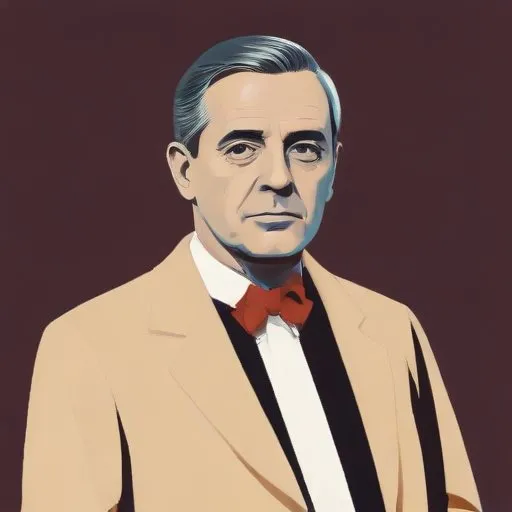
A prominent figure in American politics and law, serving as a US Attorney General and playing a key role in the Nuremberg Trials. Known for his strong advocacy for human rights and international justice.
Keenan's unrelenting pursuit of accountability for the war crimes committed by the Japanese military elite was a testament to his strong sense of morality and his commitment to upholding the principles of international law. His tireless efforts were instrumental in bringing closure to the victims of the war and their families, and his work continues to serve as a beacon of hope for those seeking justice in the face of unimaginable brutality.
Keenan's legal career was marked by a series of notable achievements. In 1919, he became a Special Assistant to the Ohio Attorney General, where he focused on combating organized crime. His expertise in this area led to his recruitment by U.S. Attorney General Homer Stille Cummings to serve as a Special Assistant at the U.S. Department of Justice in 1933.
In November 1945, President Harry S. Truman appointed Keenan as Chief Prosecutor for the International Military Tribunal for the Far East. This historic tribunal was tasked with investigating and prosecuting war crimes committed by Japanese leaders during World War II.
Keenan's leadership and expertise were instrumental in the successful prosecution of the high-ranking defendants, many of whom were found guilty and sentenced to death or imprisonment. The Tokyo Tribunal marked a significant turning point in the development of international law, establishing the precedent that individuals could be held accountable for war crimes and crimes against humanity.
Keenan's commitment to public service was matched only by his dedication to his family. He was married to Florence Nightingale Keenan, and the couple had two children together. Throughout his life, Keenan remained deeply devoted to his family, and his strong sense of morality was shaped by his Catholic upbringing.
Joseph B. Keenan's courageous pursuit of justice in the face of unimaginable atrocities has left an indelible mark on the world. His legacy serves as a powerful reminder of the importance of upholding the principles of international law and promoting accountability for those who commit war crimes and crimes against humanity.
Today, Keenan's work continues to inspire generations of lawyers, jurists, and human rights activists around the world. His unwavering commitment to justice and his unshakeable moral compass serve as a beacon of hope in the face of darkness, reminding us all of the power of humanity to create a more just and peaceful world.
Born in 1891
The 14th Chief Justice of the United States, a jurist and politician who led the Supreme Court through a transformative era of civil rights and social change, issuing landmark rulings like Brown v. Board of Education.
Born in 1886
A U.S. Supreme Court Justice who served for 34 years, known for his strong support of individual liberties and First Amendment rights.
Born in 1882
A renowned Supreme Court Justice and Harvard Law professor who played a significant role in shaping American law and policy, particularly in the areas of civil liberties and judicial restraint.
Born in 1898
A Supreme Court Justice who championed individual rights and environmental protection, leaving a lasting impact on American law and conservation.
Born in 1872
The 12th Chief Justice of the United States, a prominent lawyer and jurist, is most known for his significant contributions to shaping the Supreme Court's decisions and upholding the Constitution. He played a crucial role in establishing the Court's liberal wing during the New Deal era.
Born in 1892
A renowned lawyer, judge, and politician who served as the 57th US Attorney General and played a key role in the Nuremberg Trials, prosecuting Nazi war criminals.
Born in 1890
The 13th Chief Justice of the United States, who led the Supreme Court from 1946 to 1953 and played a crucial role in shaping the country's legal landscape during the post-World War II era. He's most known for his leadership during a pivotal time in American history.
85 Years Old
The Shadow Secretary of State for Scotland, a key figure in the Labour Party, advocated for Scottish devolution and played a crucial role in shaping the country's political landscape. He was a dedicated public servant, committed to improving the lives of the Scottish people.
