


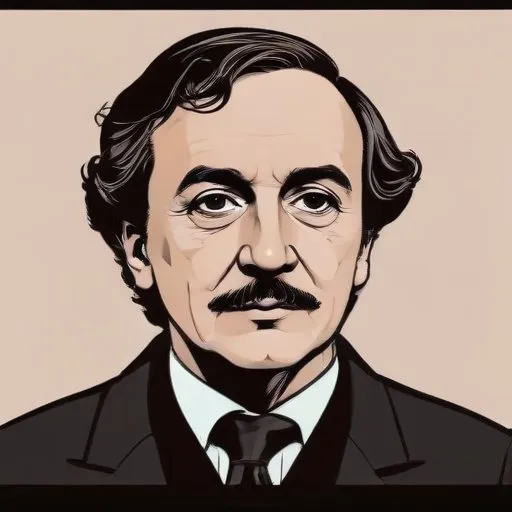
A pioneering literary critic and historian who co-founded the Goncourt Academy, awarding the prestigious Prix Goncourt to outstanding French-language literature.
Jules de Goncourt was a renowned French writer and art historian, best known for his collaborative works with his brother Edmond, which pioneered the Naturalist movement in literature. His contributions to the world of art and literature are still celebrated today, with the prestigious Prix Goncourt award being established in his honor.
Born on December 17, 1830, in Paris, Jules was the fourth child of Marc-Pierre Huot de Goncourt, a former cavalry officer, and his wife Annette-Cécile de Goncourt. His paternal grandfather, Huot de Goncourt, had sat as a deputy in the National Assembly of 1789.
Jules attended the prestigious Lyce Condorcet from 1842 to 1848, where he excelled in his studies, earning two accessits in Greek and Latin in the Concours général. Tragedy struck when both his parents passed away while he and his brother Edmond were still young, leaving them a legacy that granted them financial independence to pursue their artistic interests.
Jules and Edmond initially focused on art history scholarship, publishing books on late 18th-century history and the evolution of an era through its social existence. Their shared passion for 18th-century art led them to assemble an esteemed collection of fine and decorative art, as well as ephemera like letters, drawings, and prints.
From 1856, the brothers published a series of essays called L'Art du XVIIIe Siècle (The Art of the 18th Century), which ultimately spanned 12 fascicles and was completed in 1875. During the 1860s, they shifted their focus to novel-writing, characterizing their works with Naturalism and an examination of different social classes, thereby anticipating the work of later authors like Émile Zola.
Jules de Goncourt's untimely death on June 20, 1870, at the age of 39, was a result of a stroke brought on by syphilis. In spite of his short life, his contributions to literature and art history have had a lasting impact on the world of letters.
The Prix Goncourt, established in his honor, is one of the most prestigious literary awards in France, recognizing excellence in French literature. His collaborative works with Edmond have inspired generations of writers, including the likes of Émile Zola, and continue to be celebrated for their innovative style and social commentary.
Jules de Goncourt's writing was characterized by a strong sense of social commentary and critique. Through his works, he highlighted the hypocrisies and injustices of the time, often focusing on the struggles of the working class and women.
His Naturalist style, which emphasized the role of environment and social circumstances in shaping human behavior, paved the way for later literary movements and influenced the development of social realism.
Born in 1840
A pioneering figure in naturalist literature, known for his influential novels that exposed social ills and championed reform, such as "Germinal" and "Nana".
Born in 1821
A pioneering realist novelist who crafted meticulous, psychologically nuanced portrayals of 19th-century French life, particularly in his iconic novel "Madame Bovary".
Born in 1799
A prolific writer who created a vast array of characters and stories that explored the human condition, particularly in the context of post-Napoleonic France. His works are considered a cornerstone of French literature.
Born in 1850
A 19th-century French literary mastermind who crafted hauntingly beautiful short stories and novels that probed the human psyche, often with a dark, ironic twist. His works remain widely read and adapted today.
Born in 1821
A 19th-century literary mastermind who crafted exquisite poetry and art criticism, exploring the beauty and darkness of human experience.
Born in 1823
A 19th-century French poet and critic, known for his lyrical and expressive poetry, as well as his influential literary criticism that shaped the French Symbolist movement.
Born in 1840
A 19th-century literary mastermind, celebrated for his vivid depictions of French life and poignant short stories, particularly "The Last Lesson" and "Tartarin of Tarascon".
