


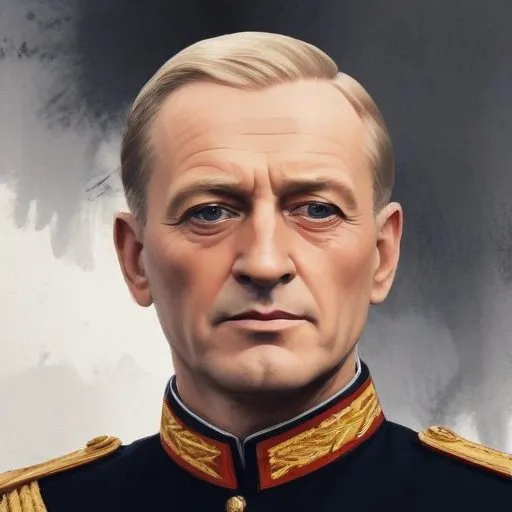
Early member of the Nazi Party and one of Adolf Hitler's closest associates, serving as the first commander of the SS-Begleitkommando, Hitler's personal bodyguard unit.
Julius Schreck, a Senior Nazi official and close confidant of Adolf Hitler, is best known for being the founding member and first leader of the Schutzstaffel (Protection Squadron), commonly referred to as the SS. As one of the most influential figures in the early years of the Nazi Party, Schreck played a pivotal role in shaping the party's ideology and structure.
Born on July 13, 1898, in Munich, Bavaria, Schreck served in the German Army during World War I. After the war, he became an early member of the National Socialist German Workers' Party (NSDAP), joining in 1920 as member number 53. It was during this time that he developed a close friendship with Adolf Hitler, which would last until his untimely death.
Schreck's rise to prominence within the NSDAP began with his involvement in the Sturmabteilung (Storm Detachment), a paramilitary wing of the party designed to disrupt political opponents and provide security. As a founding member, he played a key role in its growth and development. In 1923, Hitler ordered the formation of a small, elite bodyguard unit dedicated to his personal service and protection, which would eventually become the SS. Schreck was chosen to lead this unit, known as the Stabswache (Staff Guard), alongside Joseph Berchtold.
Under Schreck's leadership, the Stabswache evolved into the SS, with its own unique insignia, the Totenkopf (death's head), resurrected from its use by elite forces in the past. The SS was initially a small, elite unit, but it would eventually grow to become one of the most feared and powerful organizations in Nazi Germany. Schreck's vision for the SS was to create an elite corps of loyal and dedicated men, committed to the party's ideology and willing to carry out its bidding.
Schreck's close relationship with Hitler extended beyond politics. He served as Hitler's personal chauffeur for a time, and it is said that Hitler held him in high esteem. Tragically, Schreck's life was cut short when he died of meningitis on May 16, 1936. Hitler responded by giving him a state funeral, a testament to the high regard in which he was held.
While Schreck's legacy is undoubtedly tainted by his association with the Nazi Party and its atrocities, his contribution to the development of the SS cannot be ignored. The SS would go on to play a central role in the implementation of the Nazi's brutal policies, and its influence can still be felt in modern-day extremist ideologies.
Schreck's story serves as a reminder of the danger of extremism and the importance of critically evaluating the actions and ideologies of those who shape our world.
Born in 1889
The dictator of Nazi Germany, responsible for the genocide of six million Jews and millions of other people during World War II, and infamous for his extreme nationalist and anti-Semitic ideology.
Born in 1900
Leading the SS and Gestapo, he oversaw the Nazi regime's brutal security apparatus and implemented the "Final Solution," orchestrating the genocide of six million Jews during World War II.
Born in 1893
A high-ranking Nazi official, he was a decorated World War I fighter pilot and later became a prominent politician, serving as Minister President of Prussia. He's infamous for his role in the Nazi regime and war crimes trials.
Born in 1897
A mastermind of Nazi propaganda, he crafted a persuasive narrative that fueled the Third Reich's rise to power, leaving a lasting impact on the world.
Born in 1894
A high-ranking Nazi official who flew to Scotland on a solo mission to negotiate peace with the UK, but was instead arrested and imprisoned.
Born in 1893
A German diplomat who served as the Nazi regime's Foreign Minister, orchestrating key alliances and treaties that led to World War II. He was a close associate of Adolf Hitler and played a crucial role in shaping Nazi foreign policy.
Born in 1891
A German naval commander who led the U-boat fleet during World War II and briefly served as President of Germany after Hitler's death, known for his role in the war and its aftermath.
Born in 1903
Austrian-German lawyer and general who served as the highest-ranking leader of the Nazi police forces, responsible for overseeing the Gestapo, SS, and concentration camps during World War II. He was a key figure in the Holocaust and other atrocities committed by the Nazi regime.
