


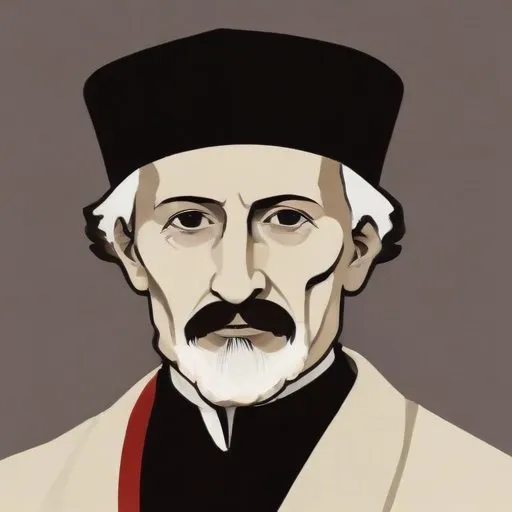
A Polish historian and philosopher who studied the development of modern philosophy, particularly the works of Immanuel Kant, and wrote extensively on ethics, metaphysics, and epistemology.
Jzef Kremer was a Polish historian of art, philosopher, aesthetician, and psychologist who made significant contributions to the field of philosophy, particularly in introducing Hegelianism to Poland. He is renowned for his groundbreaking work in aesthetics, psychology, and art history, which earned him recognition and acclaim in his lifetime.
Kremer was born on February 22, 1806, in Kraków, Poland. He pursued his academic interests in various institutions, including the University of Kraków, Berlin, Heidelberg, and Paris. This diverse educational background enabled him to develop a broad understanding of philosophical concepts, which he later applied to his work.
Kremer's academic career was marked by several notable milestones. He became a professor of philosophy at the Jagiellonian University in Kraków in 1847 and later served as the rector of the university. In 1850, he was appointed as an assistant professor, and in 1865, he became a full professor. Kremer's most influential work, "Listy z Krakowa" (Letters from Kraków), was published in 1843. This dissertation in aesthetics, written in the Hegelian spirit, brought him recognition and renown.
His other notable works include "Wykład systematyczny filozofii" (A Systematic Course of Philosophy), published in 1849 and 1852, which was one of the first systematic textbooks of philosophy in 19th-century Poland. Kremer's travelogue, "Podróż do Włoch" (Journey to Italy), published between 1859 and 1864, is considered a classic of Polish literature.
Kremer was the first proponent of Hegelianism in Poland, and his work in this area had a significant impact on the country's philosophical landscape. He introduced Hegel's ideas to the Polish academic community, which paved the way for further philosophical debates and discussions.
Kremer's philosophical contributions extended to the field of psychology, where he made a systematic division of psychic phenomena into the conscious and the unconscious. He also treated anthropology as a science that probes the mutual relations between these two.
Kremer's work was widely recognized, and he was awarded several honors during his lifetime. He was a member of the Polish Academy of Learning from its founding in 1872. His collected works were published in a 12-volume edition in Warsaw between 1877 and 1880, a testament to his significant contributions to philosophy and psychology.
Jzef Kremer's legacy extends beyond his own country, as his work influenced philosophical debates in Europe and beyond. He is remembered as a pioneer who introduced Hegelianism to Poland and made significant contributions to the fields of aesthetics, psychology, and art history.
Through his work, Kremer demonstrated the importance of interdisciplinary approaches to understanding human experience. His contributions continue to inspire scholars and researchers, ensuring his legacy as a prominent figure in the history of philosophy and psychology.
Born in 1814
A Russian philosopher and theorist who advocated for anarchism and the abolition of the state, and is known for his influence on the development of anarchist thought. His ideas emphasized individual freedom and the rejection of authority.
Born in 1818
A 19th-century philosopher who developed the theory of communism, arguing that capitalism would eventually be replaced by a socialist society. He's known for his critique of capitalism and the concept of class struggle.
Born in 1820
A 19th-century philosopher and economist who co-authored "The Communist Manifesto" with Karl Marx, shaping modern socialist and communist thought. He also wrote extensively on economics, history, and politics.
Born in 1770
A German philosopher and academic who developed a comprehensive and systematic philosophy that emphasized the unity of all things and the dialectical process of thesis, antithesis, and synthesis. His ideas have had a profound impact on modern thought, influencing fields such as philosophy, politics, and art.
Born in 1724
Developed influential philosophical frameworks, such as the Critique of Pure Reason, that shaped modern Western thought on ethics, morality, and human understanding.
