


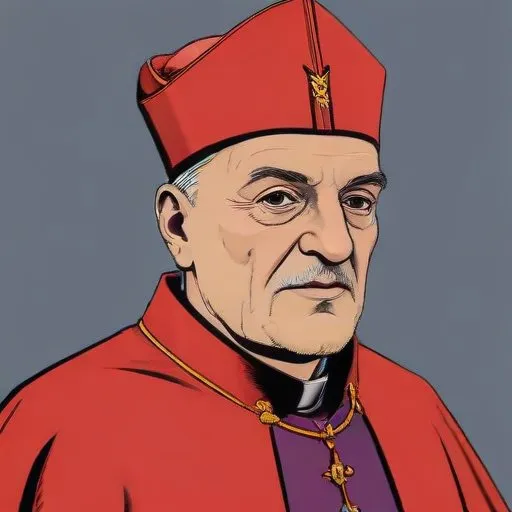
A Hungarian Catholic cardinal who fiercely opposed communism, leading to imprisonment and exile, and later became a symbol of resistance against Soviet oppression.
József Mindszenty, a Hungarian cardinal of the Catholic Church, is renowned for his unwavering opposition to fascism and communism in Hungary, earning him the reputation of a champion of human rights and freedom. As the Archbishop of Esztergom and leader of the Catholic Church in Hungary from 1945 to 1973, he fearlessly confronted the oppressive regimes, inspiring a nation and garnering international recognition.
Born on March 29, 1892, in Csehimindszent, Austria-Hungary, to József Pehm and Borbála Kovács, Mindszenty's early life was marked by his strong desire to serve the Church. He attended St. Norbert's Premonstratensian High Grammar School in Szombathely and later entered the Szombathely Diocesan Seminary in 1911.
Ordained a priest by Bishop János Mikes on June 12, 1915, Mindszenty's early writings and sermons demonstrated his commitment to social justice and his critique of socialist policies. His book, Motherhood, published in 1917, was a testament to his growing influence as a spiritual leader.
In 1939, Mindszenty urged his followers to vote against the Arrow Cross Party, a fascist organization that was gaining popularity in Hungary. His pamphlet, The Green Communism, published in 1940, boldly characterized the Hungarian Nyilas Nazi Movement as "diabolic."
During World War II, Mindszenty was imprisoned by the pro-Nazi Arrow Cross Party for his vocal opposition to their regime. After the war, he continued to speak out against communism, earning him the wrath of the Soviet-backed government.
In 1949, Mindszenty was arrested, tortured, and sentenced to life imprisonment in a highly publicized show trial that sparked international outrage. The United Nations condemned the trial, and world leaders, including U.S. President Harry S. Truman, called for his release.
In 1956, during the Hungarian Revolution, Mindszenty was freed from prison and granted political asylum by the United States embassy in Budapest. He lived in the embassy for the next 15 years, continuing to inspire the Hungarian people and advocacy for democracy and human rights.
In 1971, Mindszenty was finally allowed to leave Hungary and he passed away on May 6, 1975, in Vienna, Austria.
The cause for Mindszenty's sainthood was opened in 1993, and in 2019, Pope Francis declared him Venerable. His unwavering commitment to justice, freedom, and human dignity has inspired generations, cementing his place as a champion of the human spirit.
Through his life and legacy, József Mindszenty has left an indelible mark on Hungarian history, serving as a beacon of hope and resistance against totalitarian regimes.
József Mindszenty's unyielding spirit and courageous stance against oppression have earned him a place among the most revered figures of the 20th century, inspiring generations to stand up for justice and human rights.
Born in 1876
The leader of the Catholic Church from 1939 to 1958, known for his controversial role during World War II, particularly in regards to the Holocaust. He is also remembered for his encyclicals on social justice and liturgical reforms.
Born in 1881
Reformed the Catholic Church, introducing progressive reforms and ecumenical dialogue, and convened the Second Vatican Council.
Born in 1417
A 15th-century pope who played a significant role in the fall of the Western Schism, ending the division in the Catholic Church. He's also known for his lavish spending and nepotism.
Born in 1920
Leader of the Catholic Church from 1978 to 2005, known for helping to end communism in Poland and being a charismatic advocate for human rights and social justice.
Born in 1585
A powerful and cunning statesman who dominated French politics during the 17th century, known for his ruthless suppression of dissent and centralization of power. He was a master strategist and diplomat who shaped the course of European history.
Born in 1810
The first pope to fully embrace modernity, he issued the groundbreaking encyclical Rerum Novarum, which addressed social justice and workers' rights, shaping the Catholic Church's stance on social issues.
Born in 1876
The leader of the Catholic Church from 1939 to 1958, known for his controversial role during World War II, particularly in regards to the Holocaust. He is also remembered for his encyclicals on social justice and liturgical reforms.
