


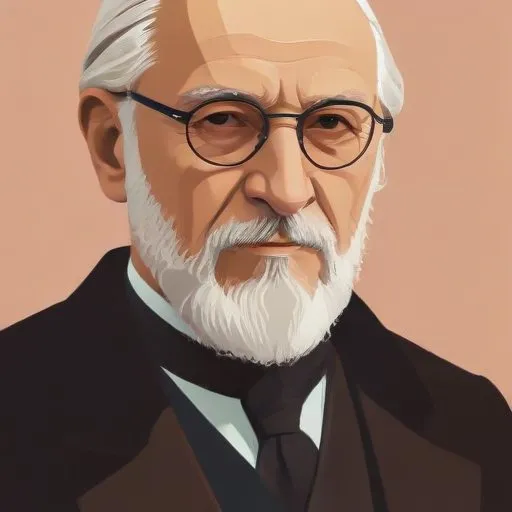
A leading Marxist theorist and critic of capitalism, known for his influential writings on socialism and democracy. His works had a significant impact on the development of Marxist thought.
Karl Johann Kautsky, a Czech-Austrian philosopher, journalist, and Marxist theorist, is renowned for his advocacy of orthodox Marxism, which emphasized the scientific, materialist, and determinist character of Karl Marx's work. His interpretation of Marxism dominated European Marxism for two decades, from the death of Friedrich Engels in 1895 to the outbreak of World War I in 1914.
Born on October 16, 1854, in Prague, Kautsky studied at the University of Vienna, where he developed his philosophical and socialist ideologies. In 1875, he joined the Social Democratic Party of Austria, marking the beginning of his lifelong commitment to socialism.
Kautsky's most significant contribution was his development of the theory of orthodox Marxism. He believed that history could not be hurried, and that politically, workers and workers' parties must wait for the material economic conditions for a socialist revolution to be met. This ideology emphasized the importance of gradualism, advocating for the use of bourgeois parliamentary democracy to improve the lives of workers until capitalism was brought down by its internal contradictions.
Kautsky's influence extended beyond Germany, shaping the socialist movements of other European countries. His theories were incorporated into the Erfurt Program of 1891, which became a major influence on other European socialist parties.
Kautsky's gradualist approach was met with criticism from other leading Marxists, including Eduard Bernstein, who favored a reformist approach, and Rosa Luxemburg, who advocated for revolutionary spontaneity. Vladimir Lenin, who initiated the Russian Revolution in 1917, was also a vocal critic of Kautsky's ideology, believing that he had delayed the revolution by advocating for gradualism.
In 1917, Kautsky briefly left the Social Democratic Party of Germany (SPD) to join the Independent Social Democratic Party of Germany (USPD) due to his opposition to the party's collaboration with the war effort. He rejoined the SPD in 1922. As his influence and involvement in politics waned, Kautsky died on October 17, 1938, in Amsterdam.
Karl Kautsky's contributions to Marxist theory continue to influence socialist movements around the world. His emphasis on gradualism and the importance of economic conditions for a socialist revolution remains a topic of debate among scholars and activists. As a leading theorist of the Second International, Kautsky's legacy is a testament to the power of ideas in shaping the course of history.
As Kautsky himself once said, "The task of the socialist is not to construct a program, but to find the way to the goal." His commitment to this principle has inspired generations of socialists and continues to inspire today.
Born in 1820
A 19th-century philosopher and economist who co-authored "The Communist Manifesto" with Karl Marx, shaping modern socialist and communist thought. He also wrote extensively on economics, history, and politics.
Born in 1870
Founder of the world's first socialist state, leading the Bolshevik Revolution and establishing the Soviet Union, known for his radical Marxist ideology and authoritarian rule.
Born in 1871
A pioneering Marxist theorist and activist who advocated for workers' rights and criticized capitalism, known for her radical ideas on revolution and democracy.
Born in 1856
A Russian philosopher and theorist who developed Marxist theory and was a key figure in the Russian Revolution, known for his writings on dialectical materialism.
Born in 1840
A leading figure in the German socialist movement, he co-founded the Social Democratic Party of Germany and advocated for workers' rights and women's equality. His writings and speeches helped shape modern socialist thought.
Born in 1871
Co-founder of the Communist Party of Germany, a key figure in the Spartacist uprising, and a vocal critic of World War I. He was a pioneering socialist leader who fought for workers' rights and social justice.
Born in 1857
A pioneering Marxist theorist and women's rights activist who played a key role in shaping socialist and feminist movements in early 20th-century Europe.
