


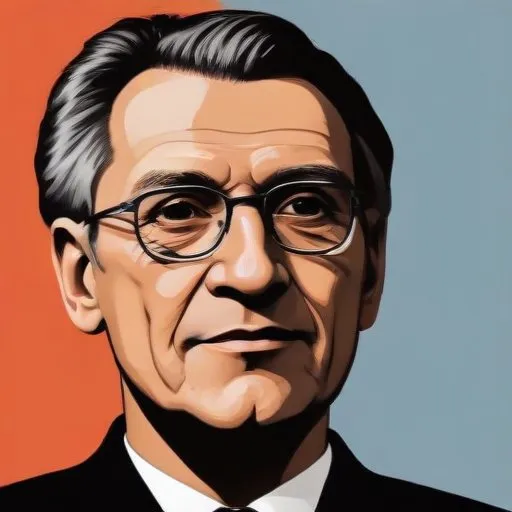
A German author and activist who wrote extensively on the dark side of Christianity, exposing its violent history and criticizing its dogmatic teachings. He's known for his provocative and well-researched works that challenge religious orthodoxy.
Karlheinz Deschner, a German researcher and writer, shook the foundations of Christianity with his scathing critiques of the Catholic Church and its history. His magnum opus, the 10-volume "Christianity's Criminal History" (Kriminalgeschichte des Christentums), exposed the darker aspects of Christianity, earning him both accolades and condemnation.
Born on May 23, 1924, in Bamberg, Bavaria, Germany, Deschner grew up in a Roman Catholic family. His father, Karl, was a forester, and his mother, Margareta, was a convert from Protestantism. He was the eldest of three children and attended the Franciscan Seminary in Dettelbach before studying at the University of Munich and later the University of Würzburg, where he earned his doctorate in 1951.
Deschner's academic pursuits spanned multiple disciplines, including law, theology, philosophy, and psychology. His doctoral dissertation, "Lenaus Lyrics As an Expression of Metaphysical Despair," demonstrated his expertise in literary analysis. He went on to become a prolific writer, publishing numerous articles and books that scrutinized the teachings and practices of Christianity.
Deschner's most notable work, "Christianity's Criminal History," is a comprehensive, 10-volume treatise that examines the Catholic Church's role in perpetuating violence, oppression, and corruption throughout history. This exhaustive critique earned him recognition as a fearless and trenchant critic of Christianity.
Deschner's uncompromising critiques of Christianity sparked heated debates, earning him both admiration and censure. His work influenced modern society by fostering critical thinking and encouraging a nuanced understanding of religious history. However, his scathing critiques also led to controversies, with some labeling him a "church critic" and others accusing him of being overly provocative.
Deschner's work reflects his commitment to intellectual honesty and his willingness to challenge established dogma. He believed in the importance of critically examining religious institutions and their role in shaping history. His philosophical contributions have inspired a new generation of scholars and thinkers to engage in open and honest discussions about the complexities of religious history.
Karlheinz Deschner's legacy is that of a fearless critic who dared to challenge the status quo. His work has left an indelible mark on the literary and academic landscapes, inspiring future generations to critically examine the role of religion in shaping human history.
By the time of his passing on April 8, 2014, Deschner had cemented his place as a provocative and influential thinker, leaving behind a body of work that continues to inspire, provoke, and educate.
Born in 1898
A pioneering playwright and poet who revolutionized theater with his epic style, blending politics and art to create socially conscious works that continue to influence contemporary drama.
Born in 1885
A German philosopher who explored the concept of utopia and the human desire for a better world, influencing Marxist thought and critical theory.
Born in 1903
A critical theorist who critiqued modern society, culture, and capitalism, arguing that they perpetuate inequality and stifle individual freedom. His work influenced many fields, from sociology to musicology.
Born in 1898
A critical theorist who challenged traditional notions of freedom, democracy, and consumerism, arguing that modern society is oppressive and dehumanizing.
Born in 1905
Existentialist philosopher and playwright who argued that humans have complete freedom to choose their actions and create their own meaning in life, influencing modern thought on morality and individual responsibility.
Born in 1889
A German philosopher and academic who explored the meaning of existence, time, and human existence, influencing 20th-century philosophy with his concept of "Being-in-the-world".
Born in 1900
A German psychologist and sociologist who developed the concept of "social character" and explored the relationship between psychology and society, known for his humanistic and socialist approach.
Born in 1902
A German philosopher and journalist who critiqued modern technology's effects on humanity, warning of its potential to dehumanize and control society. His work explored the consequences of nuclear war and the responsibility of scientists.
