


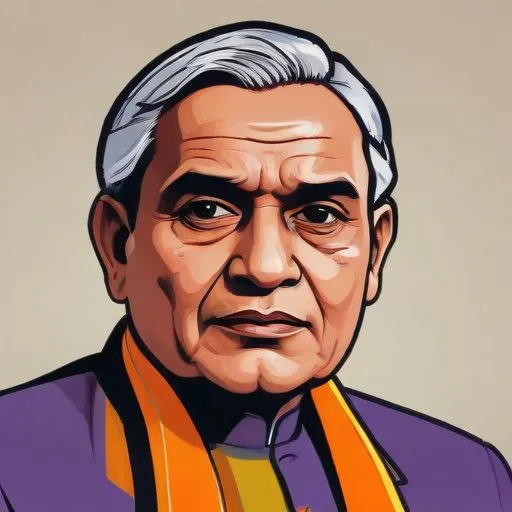
A champion of social justice and education, he worked tirelessly to empower the marginalized and uplift the state of Bihar through his visionary leadership.
Karpoori Thakur, fondly known as Jan Nayak or the People's Hero, was a stalwart Indian politician who served two terms as the Chief Minister of Bihar. He is revered for his unwavering commitment to social justice, linguistic equality, and the empowerment of the underprivileged.
Born on 24 January 1924, in Pitaunjhia village, Samastipur District, Bihar, Thakur belonged to the Nai community. His parents, Gokul Thakur and Ramdulari Devi, instilled in him a strong sense of social responsibility, which was further reinforced by his exposure to Mahatma Gandhi's ideology and the teachings of Satyanarayan Sinha.
Thakur's involvement in the Indian independence movement began at a young age. He left his graduate college to join the Quit India Movement, for which he was arrested and spent 26 months in prison. After India gained independence, he worked as a teacher in his village school, while continuing to be an active member of the All India Students Federation.
In 1952, Thakur became a member of the Bihar Vidhan Sabha from Tajpur constituency as a Socialist Party candidate. He was arrested again in 1960 for leading P & T employees during the general strike of Central Government employees. His unwavering dedication to the cause of the working class earned him recognition and respect.
On 26 January 2024, Karpoori Thakur was posthumously awarded India's highest civilian honor, the Bharat Ratna, by the Government of India. This recognition is a testament to his selfless dedication to the people of Bihar and his unwavering commitment to social justice.
Thakur's philosophy was rooted in the principles of social equality, linguistic empowerment, and economic justice. He believed in the power of education to uplift the marginalized and worked tirelessly to promote Hindi as a symbol of national pride.
Karpoori Thakur's legacy continues to inspire generations of Indians, particularly in Bihar, where he is revered as a champion of social justice and linguistic equality. His commitment to education, empowerment, and social upliftment has left an indelible mark on the state's development.
"The power of education lies not in the language, but in the minds of the people."
"We must empower our people, not merely educate them."
Karpoori Thakur's life and legacy serve as a beacon of hope, inspiring us to strive for a more just and equitable society, where every individual has the opportunity to thrive.
Born in 1917
Indian statesman who played a key role in India's struggle for independence and later served as the Chief Minister of Bihar, known for his efforts to promote education and social reform.
Born in 1884
India's first president, a key figure in the country's struggle for independence, who played a crucial role in shaping the nation's early years. He's revered for his leadership and commitment to democracy.
Born in 1908
The 4th Deputy Prime Minister of India, a key figure in the country's struggle for independence and a champion of social justice, known for his tireless work in uplifting the marginalized.
Born in 1917
The first female Prime Minister of India, serving from 1966 to 1977 and again from 1980 until her assassination in 1984, known for her strong leadership and economic reforms.
Born in 1896
Fourth Prime Minister of India, known for his efforts to decentralize power and promote economic development, and for being the first Indian Prime Minister to resign from office.
Born in 1902
A key figure in India's freedom movement and a champion of social justice, known for leading mass movements against corruption and advocating for democratic reforms.
