


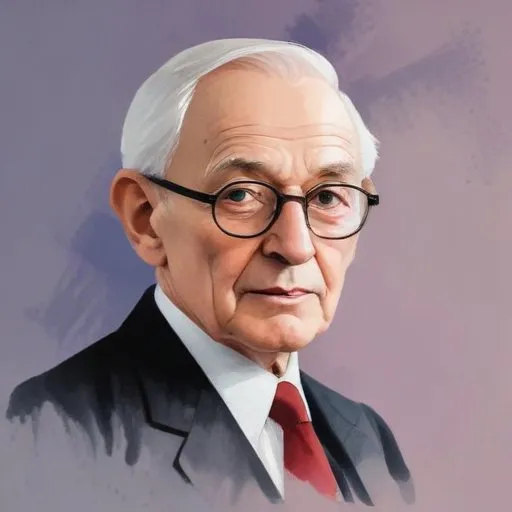
A pioneer in the field of economics, he developed the concept of "spaceship earth," highlighting the planet's limited resources and the need for sustainable development. His work also explored the intersection of economics, ecology, and social systems.
Kenneth E. Boulding, a renowned English-born American economist, educator, peace activist, and interdisciplinary philosopher, left an indelible mark on the world of economics and social science. Best known for his pioneering work in developing the concept of general systems theory, Boulding's contributions continue to influence modern thought and inspire a new generation of scholars.
Born on January 18, 1910, in Liverpool, England, Boulding was raised in a family of modest means. His father, William C. Boulding, was a gas fitter and a lay preacher in the Wesleyan Methodist Church, while his mother, Elizabeth Ann Boulding, was a homemaker. The values of pacifism and social justice instilled in him during his formative years would later shape his intellectual pursuits.
Boulding's academic excellence earned him a scholarship to Liverpool Collegiate School, followed by a chemistry scholarship to Oxford University's New College in 1929. He soon shifted his focus to Philosophy, Politics, and Economics, under the guidance of esteemed tutors Henry Phelps Brown and Maurice Allen. Boulding's exceptional talent was recognized with a First in economics in 1931.
Boulding's groundbreaking work in economics, social science, and peace activism led to the development of several influential intellectual projects. His seminal book, "The Image: Knowledge in Life and Society" (1956), is a citation classic that explores the concept of knowledge as an essential component of human society. Another notable work, "Conflict and Defense: A General Theory" (1962), provides a comprehensive framework for analyzing conflict resolution and defense strategies.
As a co-founder of general systems theory, Boulding's work synthesized concepts from economics, biology, psychology, and other disciplines to create a holistic understanding of complex systems. This interdisciplinary approach has far-reaching implications for fields such as environmental sustainability, social justice, and global politics.
Boulding's personal life was marked by a strong sense of commitment to social justice and pacifism. He was married to sociologist Elise M. Boulding, with whom he shared a deep understanding of the importance of interdisciplinary collaboration. Together, they founded the International Peace Research Association and the Journal of Conflict Resolution.
In his later years, Boulding continued to advocate for peace and nuclear disarmament, serving as a vocal critic of the Vietnam War. His tireless efforts to promote international cooperation and conflict resolution earned him recognition as a leading voice in the field of peace studies.
Kenneth E. Boulding's contributions to economics, social science, and peace activism have left a lasting legacy. His work has inspired generations of scholars, policymakers, and social activists to approach complex problems with a holistic, interdisciplinary perspective. As a testament to his enduring influence, Boulding's ideas continue to shape modern thought in areas such as sustainable development, conflict resolution, and global governance.
Through his pioneering work, Boulding has left an indelible mark on the world, encouraging us to strive for a more just, peaceful, and harmonious society. As we navigate the complexities of the 21st century, his vision and ideas remain a beacon of inspiration, guiding us toward a brighter future.
"The world is a complex system, and we must approach it as such. We cannot afford to be simplistic in the face of complexity."
"Peace is not merely the absence of war, but the presence of justice, equality, and harmony."
Kenneth E. Boulding received numerous awards and honors for his contributions to economics, social science, and peace activism, including:
As we reflect on the life and legacy of Kenneth E. Boulding, we are reminded of the power of visionary thinking and interdisciplinary collaboration. His work continues to inspire us to strive for a more just, peaceful, and harmonious world. As we move forward in the 21st century, Boulding's ideas will remain a guiding force, illuminating the path toward a brighter future for all.
Born in 1883
A pioneering economist who revolutionized modern economic theory with his groundbreaking ideas on government intervention and fiscal policy, shaping global economic policies.
Born in 1915
A renowned economist and academic who made significant contributions to the field of economics, particularly in the areas of macroeconomics and international trade. He was awarded the Nobel Prize in Economics in 1970.
Born in 1912
A Nobel Prize-winning economist who championed free market capitalism and limited government intervention, known for his advocacy of laissez-faire economics and influential writings on monetary policy.
83 Years Old
A Nobel Prize-winning economist and academic who has made significant contributions to the field of economics, particularly in the areas of information economics and globalization.
93 Years Old
A renowned economist and philosopher who has made significant contributions to welfare economics, social choice theory, and development economics, and is known for his work on poverty, famine, and human development.
93 Years Old
A pioneering economist who challenged traditional theories by showing how communities can successfully manage shared resources, leading to a Nobel Prize in Economics in 2009.
Born in 1916
A pioneer in artificial intelligence, decision-making, and problem-solving, he's renowned for his work on bounded rationality and the concept of satisficing.
95 Years Old
A pioneer in applying economic theory to social issues, he's most known for his work on human capital, crime and punishment, and the economics of the family.
