


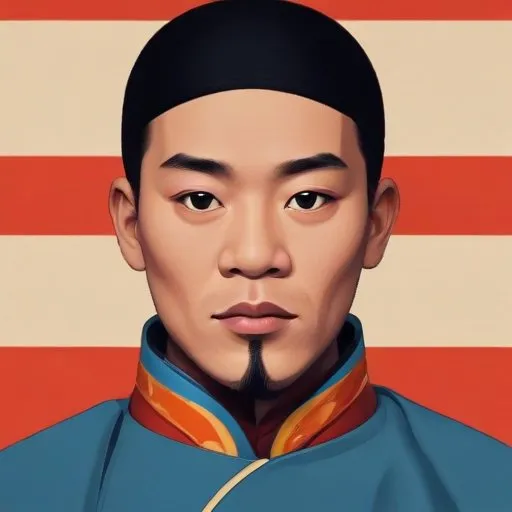
A Chinese-Japanese Ming loyalist who led a rebellion against the Qing dynasty and established Taiwan as a refuge for Ming loyalists, known for his bravery and military prowess.
Koxinga, also known as Zheng Chenggong, was a legendary Southern Ming general who resisted the Qing conquest of China in the 17th century, fighting valiantly on China's southeastern coast. He is most famous for defeating the Dutch outposts on Taiwan and establishing the Kingdom of Tungning, which ruled the island from 1661 to 1683.
Born in 1624 in Hirado, Japan, to a Chinese merchant father and a Japanese mother, Koxinga was raised in Japan until the age of seven. He later moved to Fujian province in Ming dynasty China, where he excelled in his studies and passed the imperial examination to become a Xiucai in 1638. He furthered his education at the Guozijian Imperial University, where he met renowned scholar Qian Qianyi and became his student.
In 1644, following the fall of Beijing to rebel forces, Koxinga joined the Ming remnant forces in Nanjing, which were attempting to preserve the Ming dynasty in the south. After the Manchu armies conquered Yangzhou and Nanjing, Koxinga fought alongside the Longwu Emperor, but the emperor was eventually captured and executed. Undeterred, Koxinga continued to resist the Qing conquest, earning the respect and admiration of his contemporaries.
In 1661, Koxinga led a successful campaign against the Dutch outposts on Taiwan, expelling them from the island. He established the Kingdom of Tungning, which ruled Taiwan from 1661 to 1683. This kingdom was a Ming loyalist state that continued to resist the Qing dynasty, even after the fall of the Southern Ming dynasty.
Koxinga's military campaigns were marked by bravery, strategic brilliance, and unwavering dedication to the Ming cause. He fought against the Qing armies on multiple fronts, including Taiwan, Fujian, and Guangdong. Despite facing numerous setbacks, Koxinga's resistance inspired generations of Chinese patriots and earned him a revered place in Chinese history.
In 1641, Koxinga married the niece of Dong Yangxian, an official who was a Jinshi from Huian. He had several children, including Zheng Jing, who succeeded him as the ruler of the Kingdom of Tungning. Koxinga's family played a significant role in the resistance against the Qing dynasty, with many of his descendants continuing to fight for the Ming cause.
Koxinga's legacy extends far beyond his military campaigns. He is celebrated as a national hero in Taiwan, where his resistance against the Dutch and the Qing is seen as a symbol of Taiwanese independence and resilience. His story has inspired countless works of literature, art, and film, cementing his place as one of the most beloved figures in Chinese history.
Koxinga's remarkable story is a testament to his unwavering dedication to the Ming dynasty and his unrelenting resistance against the Qing conquest. His legacy continues to inspire generations, solidifying his place as one of the most remarkable figures in Chinese history.
Born in 1537
A powerful Japanese warlord who unified Japan's warring states and led two invasions of Korea, leaving a lasting legacy in Japanese history. He's also known for his iconic Osaka Castle.
Born in 1543
Unified Japan's warring states, establishing a dynasty that ruled for over 250 years, and is revered as a brilliant military strategist and statesman.
Born in 1103
A legendary military strategist and patriot who led the Southern Song dynasty to several victories against the Jin dynasty, and is revered for his unwavering loyalty and bravery.
Born in 1130
A leading figure in Confucianism, he synthesized Confucian classics into a coherent philosophical system, influencing East Asian thought for centuries. His teachings emphasized moral cultivation and self-reflection.
