


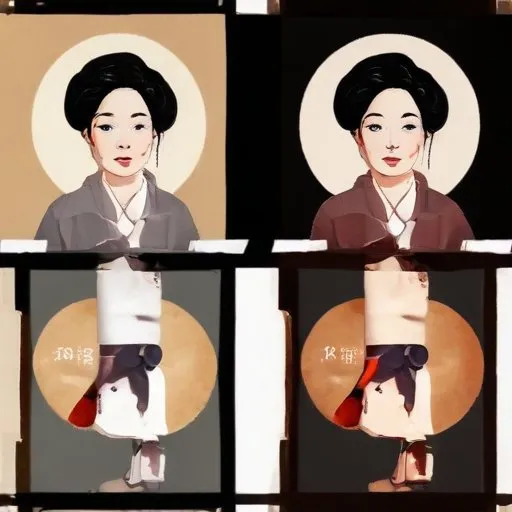
Pioneering female doctor who introduced Western medicine to Japan in the 19th century, breaking gender barriers and paving the way for future generations of women in medicine.
Kusumoto Ine, also known as O-Ine or Itoku, was a Japanese physician who made history by becoming the first female doctor of Western medicine in Japan. Born on May 31, 1827, Ine paved the way for future generations of women in medicine, leaving an indelible mark on the country's medical history.
Ine was born to Kusumoto Taki, a courtesan from Nagasaki, and Philipp Franz von Siebold, a German physician who introduced Western medical techniques to Japan. Growing up on Dejima, an artificial island off Nagasaki, Ine was exposed to Western learning and culture from a young age. After her father's banishment from Japan in 1829, Ine's mother and she were cared for by Siebold's students and associates.
Ine's determination and passion for medicine led her to study under various teachers across Japan, where she honed her skills in Western medicine. Her reputation as a skilled physician grew, earning her the patronage of the feudal lord Date Munenari. Ine's most notable achievement was assisting in the birth of one of Emperor Meiji's concubines in 1873, marking a significant milestone in her career.
Ine's life was not without its challenges. One of her teachers, who allegedly impregnated her, likely through rape, resulting in her only daughter. Ine never married, choosing instead to focus on her career and provide for her daughter. Despite these personal struggles, Ine remained dedicated to her work, leaving a lasting impact on Japan's medical community.
Ine's groundbreaking achievements have inspired numerous novels, plays, comics, and musicals in Japan, cementing her status as a cultural icon. Her legacy extends beyond the medical community, symbolizing the power of determination and perseverance in the face of adversity.
Kusumoto Ine's remarkable journey has left an indelible mark on Japan's history, inspiring generations to come. Her courage, determination, and pioneering spirit have earned her a permanent place in the annals of Japanese medical history.
Born in 1820
Pioneering nurse and statistician who revolutionized healthcare by introducing sanitation practices and data-driven decision making, becoming the founder of modern nursing.
Born in 1821
Founded the American Red Cross, providing humanitarian aid and disaster relief, and pioneering nursing education. Known for her courageous and selfless efforts during the Civil War and beyond.
Born in 1865
A British nurse who helped soldiers from both sides during WWI, and was executed by the Germans for treason, becoming a symbol of courage and compassion.
Born in 1867
Founded the Henry Street Settlement, a pioneering social service agency that provided healthcare, education, and community programs to immigrants and the working poor, and wrote extensively on social welfare and public health.
Born in 1879
A pioneering birth control activist who advocated for women's reproductive rights and founded the American Birth Control League, precursor to Planned Parenthood.
Born in 1867
A pioneering scientist who pioneered radioactivity research, discovering elements polonium and radium, and paving the way for breakthroughs in medicine and energy.
Born in 1920
A British scientist who contributed significantly to the discovery of the structure of DNA, providing high-quality X-ray crystallography images that helped James Watson and Francis Crick develop their famous model.
Born in 1912
A pioneering experimental physicist who disproved a fundamental concept in physics, the law of parity, and made groundbreaking contributions to particle physics.
