


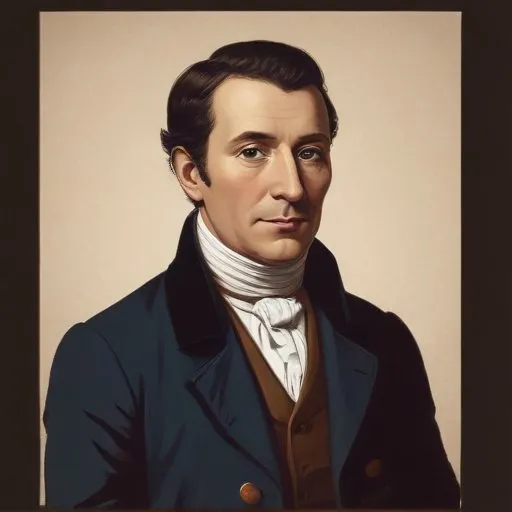
A German physician and botanist who introduced many Japanese plants to Europe and wrote extensively on Japanese flora and fauna, making significant contributions to the field of botany.
Philipp Franz von Siebold, a renowned German physician, botanist, and traveler, was born on February 17, 1796, in Würzburg, then part of the Prince-Bishopric of Würzburg, later part of Bavaria. Born into a family of doctors and professors of medicine, Siebold's early life was marked by a passion for natural sciences and a desire to explore distant lands.
Siebold's academic pursuits took him to the University of Würzburg, where he studied medicine and became a member of the Corps Moenania Würzburg. Under the mentorship of Ignaz Döllinger, a prominent professor of anatomy and physiology, Siebold's interest in natural sciences deepened. He earned his M.D. degree in 1820 and practiced medicine in Heidingsfeld, Kingdom of Bavaria, before joining the Dutch military service as a ship's surgeon.
In 1823, Siebold arrived in Japan, where he was stationed at the Dutch trading post on Dejima Island, Nagasaki. During his stay, he introduced Western medicine to Japan, taught Japanese students, and conducted extensive research on the country's flora and fauna. Siebold's work in Japan led to the publication of his seminal work, "Nippon: Archiv zur Beschreibung von Japan" (1832-1852), a comprehensive account of Japan's natural history, culture, and society.
Siebold's work was deeply influenced by the scientific ideas of his time, particularly the concept of natural history. He believed in the importance of empirical observation, collection, and classification of natural phenomena. His approach to science was characterized by a sense of wonder, curiosity, and a desire to understand the natural world.
Siebold's contributions to the fields of medicine, botany, and natural history have had a lasting impact on modern society. His introduction of Western medicine to Japan paved the way for future scientific collaborations between East and West. Today, he is remembered as a pioneering figure who bridged cultural and scientific divides.
Siebold's work can be compared to that of other prominent naturalists of his time, such as Alexander von Humboldt and Joseph Banks. While they shared similar interests and approaches, Siebold's unique experience in Japan and his contributions to the field of medicine set him apart from his contemporaries.
Siebold was awarded the Order of the Golden Spur by the King of Bavaria in 1854, and was elected a member of the Royal Netherlands Academy of Arts and Sciences in 1856.
Siebold's life and work are a testament to the spirit of scientific exploration and cultural exchange during the 19th century. His contributions to the fields of medicine, botany, and natural history continue to inspire researchers and scholars today, solidifying his place as a prominent figure in the history of science.
Born in 1743
A Swedish scientist who made significant contributions to the fields of botany, entomology, and psychology, particularly in the discovery of new plant and insect species. He's also known as the "father of South African botany" for his extensive research on the region's flora.
Born in 1651
A 17th-century German physician and botanist who traveled extensively, documenting and discovering new plant species, and writing about his experiences in Asia. His writings provided valuable insights into the cultures and natural histories of the regions he visited.
Born in 1743
A British naturalist who sailed with Captain Cook on the HMS Endeavour, discovering and cataloging thousands of plant species, and advising on the development of the British colonies. He's considered the "father of Australian botany".
41 Years Old
A Welsh rugby union player who captained Wales and the British and Irish Lions, known for his exceptional skill and leadership on the pitch.
Born in 1769
A pioneering geographer and explorer who mapped much of South America and discovered the Caspian Sea's connection to the Black Sea, greatly advancing our understanding of the natural world.
Born in 1749
A German literary giant who penned iconic works like "Faust" and "The Sorrows of Young Werther", shaping the Romantic movement and influencing countless writers.
Born in 1754
A pioneering ethnologist and journalist who traveled extensively, documenting indigenous cultures and advocating for social justice, leaving a lasting impact on our understanding of diverse societies.
