


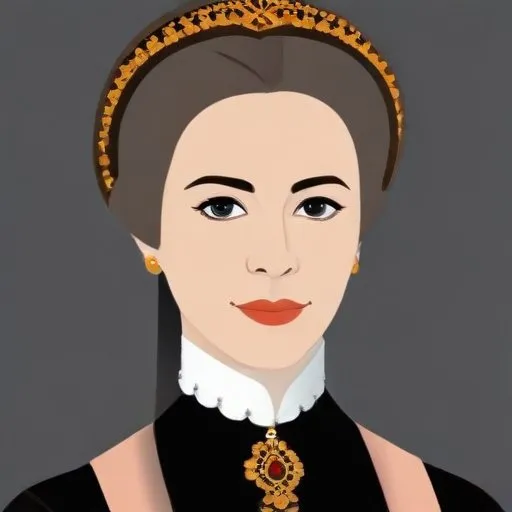
A younger sister of Lady Jane Grey, she was a claimant to the English throne and known for her secret marriage to Edward Seymour, which led to her imprisonment and downfall.
Lady Catherine Grey, a granddaughter of Mary Tudor, Duchess of Suffolk, was a prominent figure in the Tudor dynasty, known for her strong claim to the English throne and her tumultuous personal life. Catherine's descent from King Edward III and her status as a niece of King Henry VIII made her a formidable contender for the crown, earning her the attention of powerful nobles and foreign suitors.
Born on August 25, 1540, Catherine was the second daughter of Henry Grey, 1st Duke of Suffolk, and Frances Brandon, a niece of King Henry VIII. Her early life was marked by a rigorous education, focusing on languages, music, and needlework. Catherine's father, an ardent Protestant, ensured she received a comprehensive understanding of scripture and theology.
Catherine's proximity to the throne made her a significant threat to Queen Mary I (Mary Tudor, also known as Bloody Mary) and, later, Queen Elizabeth I. Her eldest sister, Lady Jane Grey, had briefly held the throne in 1553, and Catherine's own claim was strengthened by her marriage to Edward Seymour, 1st Earl of Hertford, in 1560. This union produced two sons, Edward and Thomas, further solidifying Catherine's position as a potential queen.
Catherine's marriage, however, was deemed invalid by Queen Elizabeth I, who viewed it as a threat to her own authority. Catherine was subsequently imprisoned in the Tower of London in 1562, where she remained for several years, away from her husband and children. Her release in 1573 was contingent upon her agreement to renounce her marriage and her claim to the throne.
Lady Catherine Grey's life serves as a testament to the tumultuous nature of the Tudor dynasty and the fragile nature of power during that era. Her story has inspired numerous literary and artistic works, including novels, plays, and films, ensuring her legacy endures in modern popular culture.
Catherine's life was shaped by the tumultuous reigns of her aunts, Mary and Elizabeth, and the ever-present threat of Catholicism and foreign intervention. Her personal struggles, however, also reflect the limited agency and autonomy afforded to women during the 16th century. Despite these challenges, Lady Catherine Grey remains an important figure in Tudor history, serving as a reminder of the complex web of alliances, rivalries, and inheritances that defined the era.
Born in 1516
The first queen to rule England in her own right, Bloody Mary tried to restore Catholicism, earning her notorious reputation for burning hundreds of Protestants at the stake.
Born in 1533
The Virgin Queen, a powerful and beloved monarch, ruled England during a golden age of culture, literature, and exploration, establishing the Church of England and defeating the Spanish Armada.
Born in 1284
The king whose disastrous reign led to his eventual deposition and mysterious death, remembered for his alleged homosexual relationships and power struggles with nobles.
Born in 1491
A larger-than-life monarch who ruled England with an iron fist, infamous for his six marriages and the English Reformation.
Born in 1574
An English explorer and cartographer who mapped the New World and created innovative navigational tools, contributing significantly to the development of modern cartography.
