


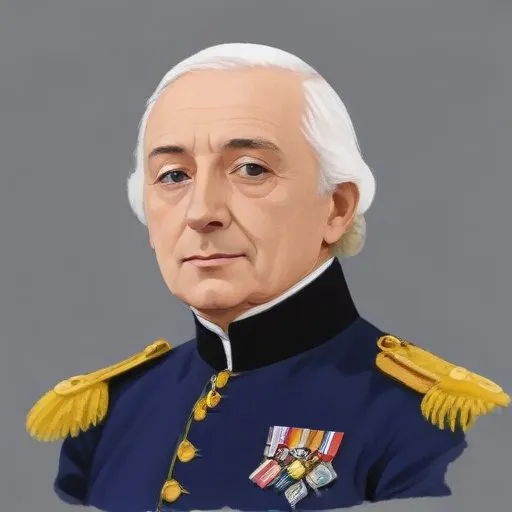
A 16th-century Flemish general and statesman who played a key role in the Dutch Revolt against Spanish rule, leading to the Eighty Years' War. He's also famous for his tragic fate, being beheaded for treason.
Lamoral, Count of Egmont, Prince of Gavere, is remembered as the courageous general and statesman whose execution sparked the national uprising that led to the independence of the Netherlands. His sacrifices paved the way for the Eighty Years War, earning him a revered place in the annals of Dutch history.
Born on November 18, 1522, at the Château de Lahamaide near Ellezelles, Lamoral was destined for greatness. As a member of one of the wealthiest and most powerful families in the Low Countries, he received a military education in Spain during his youth. His father, John IV of Egmont, was a knight in the Order of the Golden Fleece, and his mother belonged to a cadet branch of the House of Luxembourg, through whom he inherited the title Prince of Gavere.
In 1542, Lamoral inherited the estates of his elder brother Charles in Holland, further solidifying his family's stature. He was appointed Captain General of the Lowlands under Charles V and was knighted in the Order of the Golden Fleece in 1546. His military prowess was showcased in the battles of Saint-Quentin (1557) and Gravelines (1558), where he defeated the French. In 1559, at the age of 37, he became the Stadtholder of Flanders and Artois, a testament to his growing influence.
As a leading Netherlandic nobleman, Lamoral was a member of King Philip II of Spain's official Council of State for Flanders and Artois. When the King introduced the Inquisition in Flanders, Lamoral, along with William, Prince of Orange, and the Count of Horn, protested vehemently against this move. Although he threatened to resign, he eventually reconciled with the King after Granvelle, the architect of the Inquisition, left. However, this reconciliation was short-lived, and in 1565, Lamoral was arrested and accused of treason. After a sham trial, he was beheaded on June 5, 1568, in the Grand Place of Brussels.
Lamoral's execution sparked widespread outrage and resistance, ultimately contributing to the outbreak of the Eighty Years War. The war would eventually lead to the independence of the Netherlands, and Lamoral's sacrifice would be hailed as a pivotal moment in Dutch history. His fearless stand against tyranny and oppression has made him a revered figure, inspiring generations to come.
Lamoral's legacy extends beyond the realm of history. His fight for freedom and resistance against oppression continue to inspire people around the world. He serves as a symbol of courage and defiance in the face of tyranny, reminding us of the importance of standing up for what is right, even in the face of overwhelming adversity.
Born in 1545
A brilliant military commander who led the Spanish navy to a decisive victory against the Ottoman Empire at the Battle of Lepanto in 1571, turning the tide of the war in favor of Christendom.
Born in 1519
King of France from 1547 to 1559, known for his cultural and artistic patronage, and his role in the Italian Wars.
Born in 1517
A French cardinal and art collector who amassed a vast collection of Renaissance art and played a significant role in shaping the Catholic Church's response to the Protestant Reformation. He was a key advisor to European monarchs and a patron of prominent artists.
Born in 1505
Governor of the Habsburg Netherlands, known for her strong leadership and cultural patronage, fostering a golden age of arts and literature.
