


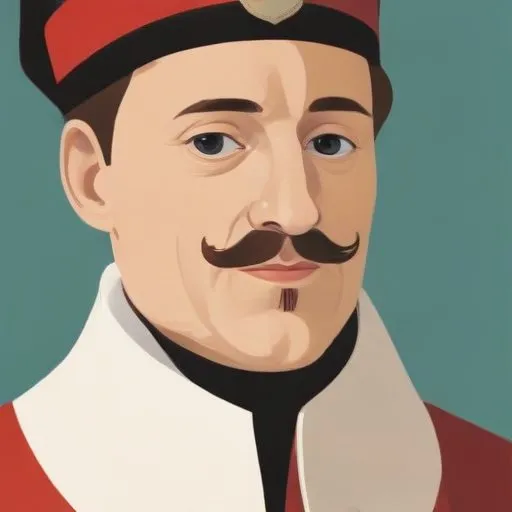
A brilliant military commander who led the Spanish navy to a decisive victory against the Ottoman Empire at the Battle of Lepanto in 1571, turning the tide of the war in favor of Christendom.
John of Austria, also known as Don John of Austria, is famous for his bravery and tactical genius as the admiral of the Holy League fleet at the Battle of Lepanto, a turning point in the war against the Ottoman Empire. As the illegitimate son of Charles V, Holy Roman Emperor, John's life was marked by controversy and uncertainty, but he rose above his circumstances to become a respected military leader and governor of the Spanish Netherlands.
John was born on February 24, 1547, in Regensburg, Upper Palatinate, to Charles V and Barbara Blomberg, a burgher's daughter. After his birth, John was taken to the castle of Luis de Quijada in Villagarca de Campos, Valladolid, where he was raised by Magdalena de Ulloa, assisted by a team of educators, including Latin teacher Guillén Prieto and chaplain García de Morales.
In 1558, Charles V officially recognized John as his son in his last will, paving the way for John's entry into the clergy. However, John's destiny lay in the military, and he eventually became a skilled and respected commander in the service of his half-brother, King Philip II of Spain.
John's military career was marked by several key victories, but his crowning achievement was the Battle of Lepanto, fought on October 7, 1571. As the admiral of the Holy League fleet, John led a coalition of Catholic states, including Spain, Venice, and the Papal States, against the Ottoman Empire. The battle was a decisive victory for the Holy League, with John's tactical prowess and bravery playing a crucial role in the outcome.
In 1576, John was appointed governor of the Spanish Netherlands, a position he held until his death in 1578. During his tenure, John worked tirelessly to maintain stability and order in the region, which was threatened by the Dutch Revolt.
John's personal life was marked by controversy and scandal, including rumors about his paternity and allegations of extravagance and recklessness. Despite these challenges, John remained a respected figure, admired for his bravery, military skill, and commitment to his country.
John's legacy extends beyond his military achievements and governorship. He played a key role in shaping the course of European history, and his bravery and tactical genius continue to inspire military leaders and historians today.
John of Austria's military career and governorship can be compared to that of his contemporaries, such as the Duke of Alba and the Earl of Leicester. While they shared similar backgrounds and experiences, John's unique circumstances and achievements set him apart from his peers.
John of Austria lived during a time of great change and upheaval in Europe, marked by the rise of Protestantism, the Ottoman Empire's expansion, and the decline of the Holy Roman Empire. Despite the challenges he faced, John's bravery, military skill, and commitment to his country have cemented his place in history as a hero of the Holy League.
Born in 1519
King of France from 1547 to 1559, known for his cultural and artistic patronage, and his role in the Italian Wars.
Born in 1545
Daughter of King Henry II of France, she was a queen of Spain through her marriage to Philip II, playing a crucial role in 16th-century European politics and diplomacy.
Born in 1578
Ruling Spain from 1598 to 1621, he oversaw the country's peak of power and cultural flourishing, while also facing challenges from the Thirty Years' War and the Inquisition.
Born in 1380
Unified the Crown of Aragon, ruling over a vast territory in eastern Spain, and sponsored the voyages of Christopher Columbus, leading to the discovery of the New World.
