


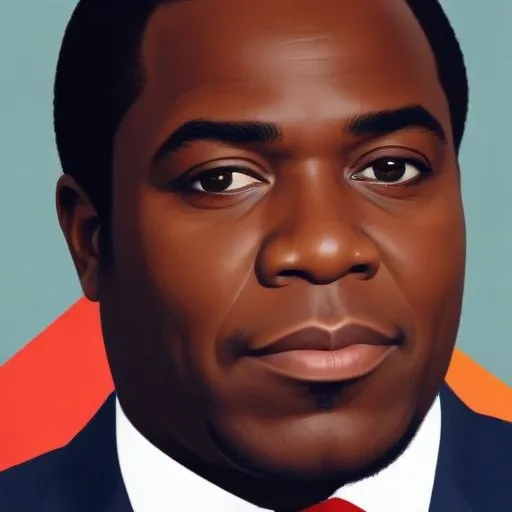
The first democratically elected president of the Democratic Republic of the Congo, who led the country to independence from Mobutu's regime and implemented economic reforms. He's also known for his mysterious assassination in 2001.
Laurent-Désiré Kabila, a name synonymous with revolution and upheaval, rose to prominence in the 1960s as a fierce opponent of Zaire's (now the Democratic Republic of Congo) authoritarian leader, Mobutu Sese Seko. Kabila's journey, marked by twists and turns, would ultimately lead him to the presidency, only to meet a tragic end at the hands of one of his own bodyguards.
Born on November 27, 1939, in Baudouinville, Katanga Province (now Moba, Tanganyika Province), Kabila was a product of the Luba and Lunda ethnic groups. His early life was shrouded in mystery, with claims of studying abroad in Paris, Tashkent, Belgrade, and Dar es Salaam, although no concrete evidence has been found to support these assertions.
Kabila's political awakening came during the 1960s Congo crisis, when he joined the Simba rebellion and later led the communist-aligned Fizi rebel territory until the 1980s. His anti-Mobutu stance earned him the respect and admiration of many Congolese, who saw him as a champion of democracy and freedom.
In the 1990s, Kabila reemerged as the leader of the Alliance of Democratic Forces for the Liberation of Congo (ADFLC), a Rwandan and Ugandan-sponsored rebel group. The ADFLC invaded Zaire in 1996, and by 1997, Kabila had overthrown Mobutu, becoming the third President of the Democratic Republic of Congo.
As president, Kabila faced the daunting task of rebuilding a war-torn nation. He attempted to assert his independence by ordering the departure of all foreign troops from the country in 1998, following the Kasika massacre. This move, however, ultimately led to the Second Congo War, as his former Rwandan and Ugandan allies began sponsoring rebel groups to overthrow him.
On January 16, 2001, tragedy struck when Kabila was assassinated by one of his bodyguards. Ten days later, his 29-year-old son, Joseph, succeeded him as president.
Kabila's tumultuous life and presidency have left an indelible mark on the Democratic Republic of Congo. While his reign was marked by controversy and instability, he remains a complex figure, driven by a desire for democracy and self-determination. His assassination has become a symbol of the ongoing struggle for power and peace in the region.
Kabila's political philosophy was shaped by his experiences as a rebel and his commitment to democracy and self-determination. He believed in the importance of African independence and the need for the Democratic Republic of Congo to chart its own course, free from foreign influence.
Kabila's legacy continues to shape the Democratic Republic of Congo's political landscape. His presidency, although marked by turmoil, paved the way for future generations of Congolese leaders. His fight for democracy and independence serves as a beacon of hope for a nation still struggling to find its footing.
55 Years Old
A Congolese soldier-turned-politician who ruled the Democratic Republic of the Congo from 2001 to 2019, known for his controversial presidency marked by corruption and human rights abuses.
96 Years Old
A ruthless dictator who ruled Zaire with an iron fist, notorious for embezzling millions and plunging his country into economic chaos.
Born in 1925
The first Prime Minister of the Democratic Republic of the Congo, a key figure in the country's struggle for independence from Belgium, and a symbol of African nationalism. He played a crucial role in shaping the country's early years, but his life was cut short by assassination.
68 Years Old
The leader who oversaw Rwanda's transformation from devastating genocide to economic growth and stability, known for his authoritarian rule and human rights controversies.
Born in 1924
The 2nd President of Zimbabwe, a controversial figure who ruled with an iron fist, known for his country's economic downfall and human rights abuses.
84 Years Old
African strongman who ruled Equatorial Guinea with an iron fist for over 40 years, accused of human rights abuses and corruption.
