


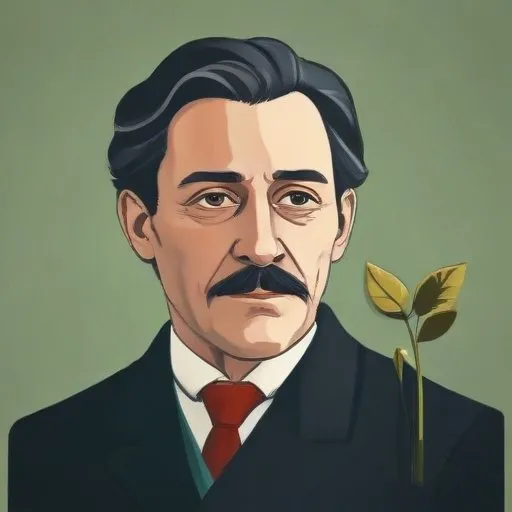
A 16th-century German physician and botanist who traveled extensively throughout the Middle East, discovering and documenting numerous plant species, and writing about his findings in a influential book. He is considered one of the founders of modern botany.
Leonhard Rauwolf, a 16th-century German physician, botanist, and traveler, is renowned for his groundbreaking expedition to the Levant and Mesopotamia in search of medicinal herbs and plants. His remarkable journey, which spanned from 1573 to 1575, marked a significant milestone in the history of botany, as he became the first European botanist of the post-medieval era to explore the regions of Syria and Mesopotamia.
Rauwolf was born on June 21, 1535, in Augsburg, Bavaria. He pursued his early education at the University of Wittenberg and later studied botany and medicine at the University of Montpellier and University of Valence in southern France. During his time in Montpellier, he was a pupil of the esteemed botanist Guillaume Rondelet, who had a profound influence on his work.
In 1573, Rauwolf embarked on his epic journey to the Near East, made possible by his brother-in-law, Melchior Manlich, who hoped to benefit from the trade of new plants and drugs. Starting from Augsburg, Rauwolf traveled to Marseilles, southern France, and then sailed to Tripoli in Lebanon. He spent several months in Aleppo, where he gathered valuable information and collected numerous plant specimens.
From Aleppo, Rauwolf journeyed to Baghdad and Mosul, documenting his experiences and discoveries along the way. In 1575, he returned to Aleppo and then traveled to Jerusalem, finally returning to Augsburg in 1576.
Rauwolf's expedition resulted in the publication of his fourth herbarium, Viertes Kreutterbuech, which included descriptions of numerous new plant species he had discovered during his travels. This seminal work not only showcased his meticulous observations but also provided a foundation for future botanical studies in the region.
Rauwolf's journey and subsequent publications had a profound impact on the development of botany in Europe. He introduced many new plant species to European botanists, stimulating further research and exploration. His work also paved the way for future travelers and botanists, inspiring a new generation of scientists to explore the natural wonders of the East.
Rauwolf married in 1565 and established a medical practice in his hometown of Augsburg. He continued to work as a physician and botanist until his death on September 15, 1596.
Today, Leonhard Rauwolf is remembered as a trailblazing botanist and explorer who expanded our understanding of the natural world. His remarkable journey to the East not only enriched our knowledge of botany but also left an indelible mark on the history of scientific discovery.
Rauwolf's story serves as a testament to the power of human curiosity and the importance of exploring the unknown. His legacy continues to inspire scientists, botanists, and travelers alike, reminding us of the significance of cultural exchange and the pursuit of knowledge.
Born in 1514
A pioneering figure in the study of human anatomy, known for performing detailed dissections and creating accurate drawings of the body's inner workings, revolutionizing medical understanding.
Born in 1516
A 16th-century Renaissance polymath who cataloged and described thousands of plants and animals, laying the foundations for modern taxonomy and zoology.
Born in 1522
A 16th-century Renaissance scholar who cataloged and described numerous plant and bird species, laying the foundation for modern taxonomy and ornithology. His work remains a valuable resource for scientists today.
Born in 1517
A 16th-century Flemish physician and botanist who wrote the influential book "Cruydeboeck" (1554), a comprehensive guide to plants and their medicinal properties.
Born in 1526
A Flemish botanist and academic who introduced exotic plants to European gardens and wrote influential botanical books, laying the foundation for modern botany.
