


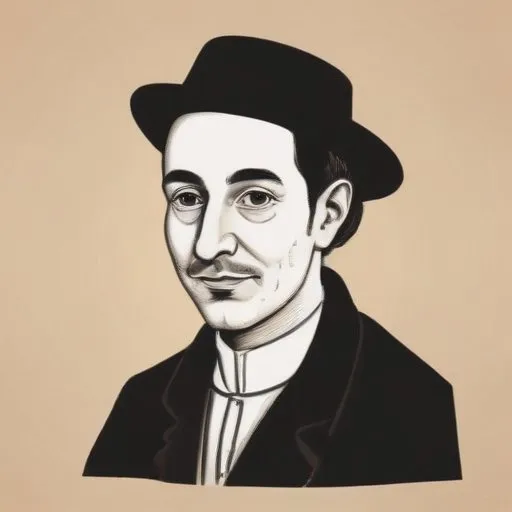
A 16th-century Flemish physician and botanist who wrote the influential book "Cruydeboeck" (1554), a comprehensive guide to plants and their medicinal properties.
Rembert Dodoens, a Flemish physician and botanist, is renowned as the "father of botany" for his groundbreaking contributions to the field of botany. He is best known for his extensive works on plant classification, medical botany, and his cataloging of over 1,000 plant species, earning him the esteemed title as one of the most influential botanists of the 16th century.
Rembert Dodoens was born Rembert van Joenckema on June 29, 1517, in Mechelen, the capital of the Spanish Netherlands. His parents, Denis van Joenckema and Ursula Roelants, were of Frisian origin, with his father being a municipal physician and private physician to Margaret of Austria, Governor of the Netherlands. Dodoens' interest in medicine and botany was likely sparked by his father's profession and the intellectual atmosphere of Margaret of Austria's court.
Dodoens received his education at the municipal college in Mechelen before pursuing his studies in medicine, cosmography, and geography at the University of Leuven (Louvain). He graduated with a licentiate in medicine in 1535 and embarked on extensive travels across Europe, including Italy, Germany, and France, until 1546.
In 1539, Dodoens married Kathelijne De Bruyn, a member of a medical family in Mechelen. They had four children: Ursula, Denijs, Antonia, and Rembert Dodoens. After Kathelijne's death in 1572, Dodoens married Maria Saerinen and had a daughter, Johanna.
In 1548, Dodoens followed in his father's footsteps by becoming one of the three municipal physicians in Mechelen. During his medical career, he wrote several influential books on medicine and botany, including Cosmographica (1548) and Cruydeboeck (1554), which showcased his expertise in plant classification and medical botany.
Dodoens' most significant contribution to botany is his cataloging of over 1,000 plant species, many of which were unknown in Europe at the time. His work introduced new species and expanded the understanding of plant classification, earning him the title "father of botany." The standard author abbreviation "Dodoens" is used to indicate him as the author when citing a botanical name.
Rembert Dodoens' works had a profound impact on the development of botany, medicine, and natural history. He laid the foundation for future botanists and inspired a new generation of scientists, including Carolus Clusius and Conrad Gesner. Dodoens' legacy extends beyond his own lifetime, as his discoveries and writings continue to influence botanical research and plant classification to this day.
Dodoens was recognized for his contributions to science and medicine during his lifetime. He was appointed as a municipal physician in Mechelen, a prestigious position that acknowledged his expertise and reputation.
Throughout his life, Dodoens was driven by a passion for discovery and a dedication to advancing the understanding of botany and medicine. His extensive travels, marriages, and children are a testament to his multifaceted personality and commitment to his work.
Born in 1514
A pioneering figure in the study of human anatomy, known for performing detailed dissections and creating accurate drawings of the body's inner workings, revolutionizing medical understanding.
Born in 1452
Renaissance mastermind behind iconic works like the Mona Lisa and The Last Supper, who revolutionized art, science, and engineering with his inventive and curious nature.
Born in 1564
Pioneering astronomer, physicist, and mathematician who played a major role in the Scientific Revolution, making key discoveries that challenged Aristotelian views and laid the foundation for modern science.
Born in 1578
Discovered the circulatory system and described how blood flows through the body, revolutionizing understanding of human physiology.
Born in 1632
Pioneering microbiologist who discovered microorganisms like bacteria, yeast, and protists, laying the foundation for modern microbiology.
Born in 1707
Developed the system of binomial nomenclature, which is still used today to classify and name living organisms. This system has had a profound impact on the fields of biology, ecology, and conservation.
Born in 1809
Developed the theory of evolution through natural selection, revolutionizing our understanding of life on Earth. This groundbreaking idea transformed the fields of biology, ecology, and beyond.
Born in 1822
An Austrian monk who pioneered genetics by experimenting with pea plants, discovering the fundamental laws of heredity, and laying the foundation for modern genetics.
