


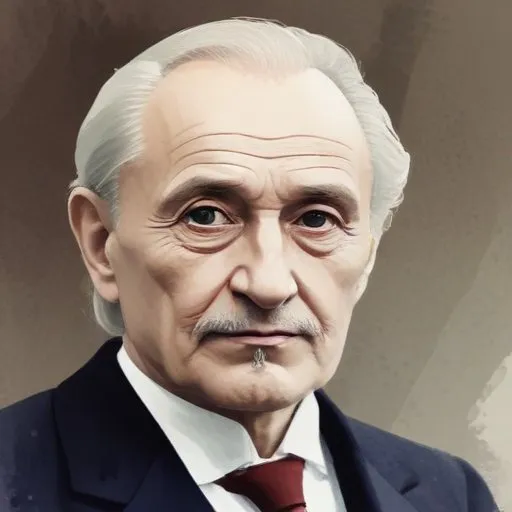
A Russian-Estonian philosopher and academic who developed a unique philosophical system that combines elements of existentialism, phenomenology, and hermeneutics, focusing on human existence and its relationship with culture.
Leonid Stolovich, a Russian-Estonian philosopher, is renowned for his groundbreaking contributions to the field of aesthetics, axiology, and systematic pluralism. With a prolific career spanning over four decades, Stolovich is the author of more than forty books and 400 publications, cementing his status as a leading authority in philosophical thought.
Born on July 22, 1929, in Leningrad, Stolovich's intellectual curiosity was evident from an early age. He pursued higher education at Leningrad University, graduating in 1952. Thereafter, he began his academic journey at Tartu University, Estonia, where he worked until his retirement in 1994, eventually becoming a professor emeritus.
Stolovich's scholarly pursuits focused on the intricate realms of aesthetics, axiology, and pluralism. His works elucidate the complexities of beauty, truth, and goodness, shedding light on the dialectical relationships between these fundamental concepts. His magnum opus, Pluralism in the Philosophy and the Philosophy of Pluralism (2005), exemplifies his ongoing quest to reconcile the dichotomies of monism and pluralism.
During the Perestroika era, Stolovich actively participated in the pro-democracy movement, Popular Front of Estonia, advocating for greater freedom and autonomy. His philosophical convictions were mirrored in his commitment to promoting democratic values and social justice.
Stolovich's intellectual legacy extends beyond the boundaries of academic philosophy. His ideas have permeated the realms of art, culture, and society, inspiring new generations of thinkers and creatives. As a testament to his enduring impact, his works continue to influence philosophical discourse, ensuring that the harmonious coexistence of beauty, truth, and goodness remains an ongoing pursuit.
Throughout his academic career, Stolovich received numerous honors and accolades for his contributions to philosophy and aesthetics. He was awarded the title of Doctor of Philosophy in 1966 and professorship in 1967, further solidifying his reputation as a distinguished scholar.
Stolovich's wisdom is encapsulated in his words: "Beauty is not just a property of things, but a dimension of being." This quote encapsulates his profound understanding of the interconnectedness of aesthetics, existence, and human experience.
Leonid Stolovich's remarkable journey has left an indelible mark on the landscape of philosophical thought. His ideas continue to inspire, provoke, and challenge, ensuring that the pursuit of beauty, truth, and goodness remains an ongoing quest for humanity.
Born in 1724
Developed influential philosophical frameworks, such as the Critique of Pure Reason, that shaped modern Western thought on ethics, morality, and human understanding.
Born in 1770
A German philosopher and academic who developed a comprehensive and systematic philosophy that emphasized the unity of all things and the dialectical process of thesis, antithesis, and synthesis. His ideas have had a profound impact on modern thought, influencing fields such as philosophy, politics, and art.
Born in 1889
A German philosopher and academic who explored the meaning of existence, time, and human existence, influencing 20th-century philosophy with his concept of "Being-in-the-world".
Born in 1905
Existentialist philosopher and playwright who argued that humans have complete freedom to choose their actions and create their own meaning in life, influencing modern thought on morality and individual responsibility.
Born in 1908
A pioneering feminist philosopher who wrote extensively on ethics, politics, and gender, famously arguing that "one is not born, but rather becomes, a woman."
Born in 1870
Founder of the world's first socialist state, leading the Bolshevik Revolution and establishing the Soviet Union, known for his radical Marxist ideology and authoritarian rule.
Born in 1856
Pioneering psychoanalyst who developed theories on the subconscious mind, childhood experiences, and the structure of personality, revolutionizing our understanding of human behavior and psychology.
