


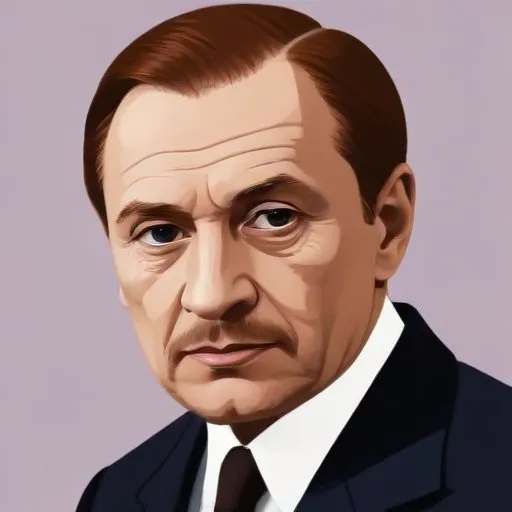
A Russian author and screenwriter, best known for his historical detective novels and screenplays that explore the intersection of history, mystery, and human drama. His works often delve into the complexities of Russian history and society.
Leonid Yuzefovich, a Russian writer, has woven a tangled web of intrigue and deception, transporting readers to the depths of pre-Revolution Russian Empire through his series of crime fiction stories. With a distinctive flair for crafting whodunits that ensnare the reader, Yuzefovich's work has captivated audiences worldwide, earning him the title of Russia's crime fiction maestro.
In 1975, Yuzefovich embarked on a dual journey, balancing his passion for teaching with his love for writing. As a history teacher at a Moscow school, he instilled in his students a deep appreciation for the past, while secretly nurturing his creative muse. This dichotomy continued until 2004, when he finally retired from teaching, allowing him to focus on his writing full-time.
In 1981, Yuzefovich earned his Ph.D. Candidate of Sciences with a thesis on Russian diplomatic etiquette of the 15th-17th centuries, demonstrating his depth of knowledge and understanding of the country's rich history.
Yuzefovich's early fiction works, though occasionally published in the USSR during the late 1970s and 1980s, failed to gain widespread recognition. It was not until the publication of his non-fiction book, The Sovereign of the Desert, in 1993, that he began to make a name for himself. This book, which told the story of Roman Ungern von Sternberg, would later inspire Victor Pelevin's novel Chapayev and Void, published in 1996.
In 2001, Yuzefovich's writing career took a dramatic turn when he shifted his focus to detective stories set in the late 19th century. This move marked the birth of his iconic character, Detective Ivan Putilin, who would go on to become a household name in Russia.
In 2003, Yuzefovich's detective story, Kazaroza, was shortlisted for the Russian Booker Prize, solidifying his position as a master of the genre.
In 2009, Yuzefovich won the prestigious Big Book, the Russian national literary award, for his novel Cranes and Pygmies. This honor catapulted him to the forefront of Russian literature, cementing his status as a literary giant.
In 2016, he was awarded the National Bestseller Literary Prize for his book The Winter Road, further solidifying his reputation as a master storyteller.
Yuzefovich's works have been translated into multiple languages, including English, French, German, Italian, Mongolian, Polish, and Spanish, making him a global phenomenon in the world of crime fiction.
As a testament to his enduring legacy, Yuzefovich's daughter, Galina, a prominent literary critic, has become a respected figure in her own right, known for her influential reviews and critiques.
Through his remarkable body of work, Leonid Yuzefovich has not only captivated readers but has also left an indelible mark on the literary world, weaving a tapestry of intrigue and deception that will continue to enthrall audiences for generations to come.
71 Years Old
A Russian literary figure known for blending satire, science fiction, and social commentary in his works, often exploring themes of politics, history, and morality. His writings are often provocative and thought-provoking, pushing boundaries and challenging societal norms.
Born in 1880
A Russian literary giant, known for pioneering the avant-garde movement in literature, blending poetry and prose to create innovative, symbolic works that explored the human experience.
Born in 1891
A Russian literary mastermind, famous for blending fantasy and realism in works like "The Master and Margarita", which explores the intersection of politics, philosophy, and the human condition.
Born in 1899
A Russian-born novelist and critic, renowned for crafting intricate, lyrical prose and exploring themes of identity, morality, and the human condition through works like "Lolita" and "Pale Fire".
Born in 1899
A Soviet writer and poet, known for his unique blend of realism and mysticism, exploring the human condition and the Russian Revolution in his works. His writing often blurred the lines between poetry and prose, creating a distinctive style.
Born in 1884
A Russian journalist and author who wrote influential dystopian novels, most notably "We", a precursor to George Orwell's "1984".
Born in 1905
A Russian absurdist writer, known for his surreal and often humorous short stories, poetry, and plays that critique Soviet society. His unique style blends wit and darkness, leaving readers both entertained and unsettled.
