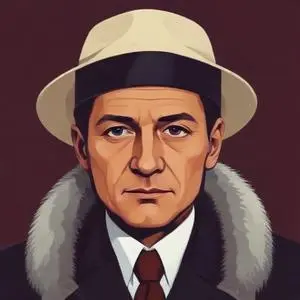
The Visionary Dissident: Yevgeny Zamyatin's Daring Literature
A Pioneer of Dystopian Fiction
Yevgeny Zamyatin, a Russian author, philosopher, and literary critic, is best known for his groundbreaking novel
We, a dystopian masterpiece that predates
George Orwell's
1984 and
Aldous Huxley's
Brave New World. Written in 1921,
We was the first work banned by the Soviet censorship board, sparking a chain of events that would shape Zamyatin's life and cement his legacy as a pioneering dissident.
A Life of Rebellion and Resistance
Born on February 1, 1884, in Lebedyan, Tambov Governorate, Russia, Zamyatin was the son of a Russian Orthodox priest and schoolmaster. His early life was marked by a loss of faith in Christianity, which led him to become a Bolshevik. As a member of the pre-Revolutionary underground, Zamyatin was repeatedly arrested, beaten, imprisoned, and exiled.
The Birth of a Dissident
Despite his early enthusiasm for the Revolution, Zamyatin soon became disillusioned with the Soviet Union's increasingly totalitarian policies. He voiced his dissent through literature, using satire and criticism to challenge the regime's enforced conformity. This bold stance earned him the title of "a man of incorruptible and uncompromising courage" from Mirra Ginsburg.
The Ban and the Consequences
We, Zamyatin's most famous work, was banned in 1921, sparking outrage within the Party and the Union of Soviet Writers. The novel's dystopian themes and scathing critique of totalitarianism were deemed too subversive for the Soviet regime. Zamyatin's defiance led to his blacklisting, and he was eventually forced to seek permission from
Joseph Stalin to leave his homeland.
Exile and Legacy
In 1932, Zamyatin arrived in Paris, where he lived in poverty until his death on March 10, 1937. Despite the difficulties, his writings continued to inspire generations of Soviet dissidents, circulating in samizdat and fueling the flames of resistance.
Influence on Modern Society
Zamyatin's work has had a profound impact on modern society, influencing authors like Orwell, Huxley, and
Ray Bradbury. His themes of individual freedom, totalitarianism, and the dangers of unchecked power continue to resonate with readers today.
Philosophical Contributions
Zamyatin's philosophy was rooted in his belief in individual freedom and his distrust of authoritarian power. He saw literature as a tool for social commentary and critique, using satire to challenge the status quo.
Trivia and Fun Facts
- Zamyatin was a talented musician and played the piano in his spare time.
- He was an avid reader of H.G. Wells and admired his work.
- Zamyatin's novel We was first published in English in 1924, three years after it was banned in the Soviet Union.
Legacy and Impact
Yevgeny Zamyatin's work continues to inspire and challenge readers today. His legacy as a pioneering dissident and visionary author ensures that his message of individual freedom and resistance to totalitarianism will endure for generations to come.
FAQ
What was Yevgeny Zamyatins early life like?
Yevgeny Zamyatin was born on February 1, 1884, in Lebedyan, Russia. He was educated at the University of St. Petersburg and became an engineer and writer.
What were Yevgeny Zamyatins literary achievements?
Yevgeny Zamyatin was a renowned writer who penned several notable works, including the dystopian novel We. He was a key figure in the Russian literary avant-garde.
Was Yevgeny Zamyatin involved in any notable literary movements?
Yes, Yevgeny Zamyatin was involved in the Russian Futurist movement, which sought to revolutionize literature and art.
What were Yevgeny Zamyatins notable works?
Yevgeny Zamyatin wrote several notable works, including the novels We and The Islanders, as well as numerous short stories and essays.
What was Yevgeny Zamyatins legacy?
Yevgeny Zamyatin was a pioneering writer who helped to shape the course of Russian literature. His innovative style and prophetic vision have influenced generations of writers and thinkers.