


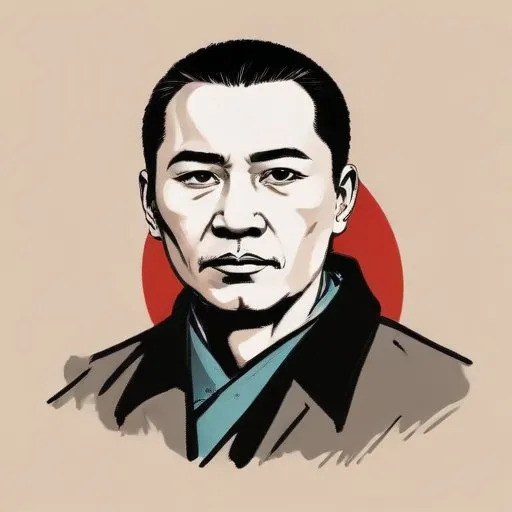
A Chinese Christian poet and journalist who was imprisoned and eventually executed for criticizing the Communist government's brutal policies during the Cultural Revolution, leaving behind a legacy of courage and defiance.
Lin Zhao, a prominent Chinese dissident, is best known for her courageous criticism of Mao Zedong's policies during the tumultuous Cultural Revolution. Her unwavering stance against the communist regime's atrocities ultimately led to her imprisonment and execution, cementing her legacy as a martyr and an emblem of resistance for Chinese Christians and human rights activists.
Born Peng Lingzhao on January 23, 1932, in Suzhou, Jiangsu province, Lin Zhao hailed from a prominent family. At just 16, she joined an underground Chinese Communist Party (CCP) cell, adopting the pen name Lin Zhao to write articles criticizing the corruption of the Nationalist government. Her activism led her to abandon her family and attend a journalism school run by the CCP, where she was eventually assigned to administer land reform in the countryside.
During her time in the countryside, Lin Zhao witnessed firsthand the brutal suppression of landlords, justified by the CCP's principle of class struggle. This exposure to the harsh realities of communist rule sowed the seeds of her future dissent. She would later enroll in the Chinese literature department at Peking University, where she became an editor of the school paper, Honglou (The Red Building), and honed her critical voice.
The Hundred Flowers Movement of 1956-1957 presented a rare opportunity for intellectuals like Lin Zhao to criticize the CCP. During this brief period, she published two poems, "It is Time" and "Party, I Call out to You," which expressed her disillusionment with communist ideologues who had never faced persecution. Her friends, Zhang Yuanxun and Shen Zeyi, founded a short-lived magazine, The Square, to discuss reform and published a poem, "This is the Time," which called for open dialogue.
In 1960, Lin Zhao's dissident activities caught up with her, and she was arrested and imprisoned. Despite facing brutal treatment, including forced labor and torture, she continued to write critically of the regime. Her final act of defiance was writing a 130,000-character essay, "Denouncing the Communist Party," using her own blood on toilet paper. Her courage ultimately led to her execution on April 29, 1968, at the age of 36.
Lin Zhao's martyrdom has inspired generations of Chinese Christians and human rights activists. Her unwavering commitment to speaking truth to power has made her an emblem of resistance against oppressive regimes. Her legacy extends beyond China, as her story serves as a powerful reminder of the importance of free speech and critical thinking in the face of authoritarianism.
Lin Zhao's story is a testament to the power of individual resistance in the face of overwhelming oppression. Her legacy serves as a beacon of hope for those fighting against human rights abuses and authoritarian regimes worldwide.
Today, Lin Zhao's name is etched in the annals of Chinese history as a symbol of courage and defiance. Her story serves as a powerful reminder of the importance of upholding human dignity and fighting against tyranny, inspiring generations to come.
Born in 1893
Leader of the Chinese Communist Party who implemented radical social and economic reforms, including the Great Leap Forward and the Cultural Revolution, shaping modern China's politics and economy.
Born in 1898
The first Premier of the People's Republic of China, serving from 1949 until his death in 1976, is most known for his key role in the Chinese Communist Party and his diplomatic efforts to improve relations with the West. He played a crucial part in shaping China's foreign policy and economy during a pivotal period in the country's history.
Born in 1898
A prominent military leader who played a crucial role in the Chinese Civil War and later became a key figure in the Communist Party, known for his criticisms of Mao's policies. He was eventually purged and persecuted during the Cultural Revolution.
Born in 1904
A Chinese revolutionary and statesman who led the country's economic reforms, transforming it into a global superpower. He's credited with opening up China to the world and introducing capitalist principles.
Born in 1886
A prominent Chinese military leader and politician who played a crucial role in the Chinese Civil War and the establishment of the People's Republic of China, serving as the second-in-command to Mao Zedong. He's most known for his military strategies and leadership during the war.
Born in 1896
A prominent Chinese military leader and politician who played a key role in the Chinese Civil War and later served as the 1st Vice Premier of the People's Republic of China, known for his efforts in modernizing the Chinese military. He was a close ally of Mao Zedong and helped establish the People's Liberation Army.
