


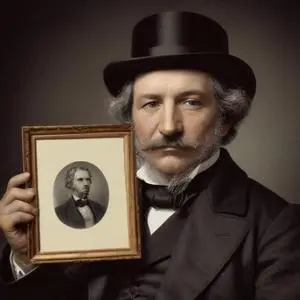
Pioneering photographer and inventor who developed the daguerreotype, a groundbreaking photographic process that captured highly detailed, permanent images.
Louis Daguerre, a French artist and photographer, is renowned for inventing the daguerreotype process of photography, a pioneering achievement that earned him the title "one of the fathers of photography." This innovative technique, announced in 1839, revolutionized the art of capturing images and paved the way for modern photography.
Born on November 18, 1787, in Cormeilles-en-Parisis, Val-d'Oise, France, Daguerre was apprenticed in architecture, theatre design, and panoramic painting to Pierre Prévost, a French panorama painter. He honed his skills in theatrical illusion, becoming a celebrated designer for the theatre and later inventing the diorama, which premiered in Paris in 1822.
In 1829, Daguerre partnered with Nicéphore Niépce, another photography pioneer, to experiment with photography. Niépce's sudden death in 1833 didn't deter Daguerre, who continued to refine the process. His perseverance led to the development of the daguerreotype, a highly detailed and permanent image produced on a silver-coated copper plate.
On January 7, 1839, Daguerre publicly announced his invention at a joint meeting of the French Academy of Sciences and the Académie des Beaux-Arts. Although he withheld specific details, the images were met with enthusiasm, and news of the daguerreotype spread rapidly. Arrangements were made for the French government to acquire Daguerre's rights in exchange for a lifetime pension.
Daguerre's invention had a profound impact on modern society, making photography accessible to the masses. His work influenced various fields, including art, science, and journalism. The daguerreotype process remained the standard for photography until the mid-19th century, when newer technologies emerged.
Daguerre's personal life was marked by significant milestones. He married Louise Georgina Arrowsmith in 1814, and the couple had one daughter. Throughout his life, Daguerre was driven by his passion for innovation and artistic expression.
Daguerre faced criticisms for not revealing the details of his process, which led to controversy among fellow photographers and scientists. Nevertheless, his contribution to the development of photography remains unparalleled.
"I have seized the light, I have arrested its flight... I have fixed the image, and the image has become perennial." — Louis Daguerre
Louis Daguerre's groundbreaking work in photography has left an indelible mark on the art world. His innovative spirit, passion, and dedication have inspired generations of photographers, artists, and scientists. As we celebrate his legacy, we acknowledge the profound impact he had on modern society, making him truly one of the fathers of photography.
Born in 1765
French inventor credited with creating the first permanent photograph, paving the way for modern photography. Known for capturing the first permanent image, "View from the Window at Le Gras," in 1826.
Born in 1830
Pioneering photographer and cinematographer who created the first motion pictures, capturing sequences of animal and human movement in a series of still images. Known for his groundbreaking work in motion photography and its influence on the development of film.
Born in 1822
Pioneering photographer who documented the American Civil War, capturing hauntingly vivid images that humanized the conflict and preserved its history.
Born in 1815
Pioneering photographer who captured intimate, dreamlike portraits of famous figures, including Charles Darwin and Alfred, Lord Tennyson, using unconventional techniques and emphasizing emotional expression.
Born in 1857
Documenting Paris' streets, architecture, and everyday life through photographs, capturing the city's essence and beauty. 40
Born in 1890
A pioneer of avant-garde photography, this artist experimented with techniques like solarization and rayography, creating surreal, dreamlike images that blurred the line between art and photography.
Born in 1902
Pioneering landscape photographer and conservationist capturing iconic black-and-white images of the American West, advocating for environmental protection through art.
Born in 1895
Documented the lives of those affected by the Great Depression and the Dust Bowl through powerful, poignant photographs that humanized the struggles of the era. Captured iconic images that shaped the national conversation around poverty and social justice.
