


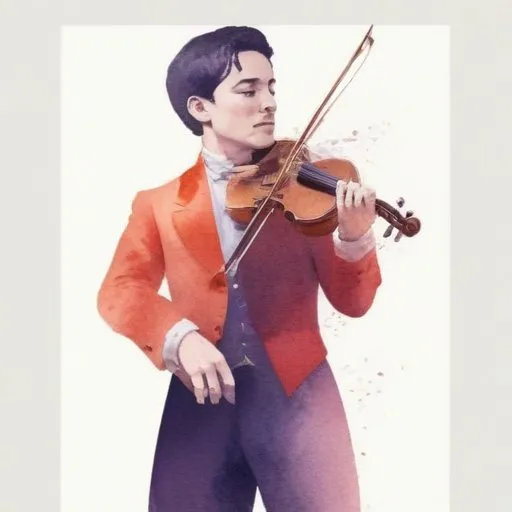
A virtuosic violinist and composer of the Baroque era, known for his innovative and expressive works that blended French and Italian styles. His compositions showcased exceptional technical skill and emotional depth.
Louis-Gabriel Guillemain was a renowned French composer and violinist, celebrated for his exceptional technique and expressive playing style. He is best known for his contributions to the classical music scene during the Baroque period, leaving an indelible mark on the world of music.
Born on November 5, 1705, in Paris, France, Guillemain was brought up by the Count de Rochechouart and began studying the violin at a young age. He later traveled to Italy to complete his training under the esteemed violinist Giovanni Battista Somis in Turin.
At the age of 24, Guillemain returned to France and quickly established himself as one of the most sought-after performers in Lyons. He was appointed first violinist of the Académie de Musique, and his Opus 1, Premier livre de sonates for violin and basso continuo, was published in Dijon in 1734.
Guillemain's talent and dedication earned him a prestigious position as musicien ordinaire to the King in 1737. He quickly rose through the ranks, becoming one of the highest-paid musicians at the court by the early 1740s. He regularly performed in private concerts before the royal couple, further solidifying his reputation as a virtuosic violinist.
Guillemain's compositions were frequently performed at the court in the late 1740s and early 1750s. His works were praised by his contemporaries, including fellow composer Louis-Claude Daquin, who wrote in his 1752 Lettre sur les hommes célèbres:
When one speaks of a man full of fire, genius, and life, one has to think of Monsieur Guillemain, Musician to the King... He is perhaps the most extraordinary and adroit violinist one can hear play.
Despite his professional success, Guillemain's personal life was marred by struggles. He was known to be a heavy drinker, especially in his later years, and his affinity for making expensive purchases often left him in debt.
Guillemain's life came to a tragic end on October 1, 1770, in Chaville, a small settlement near Paris. While some contemporary accounts describe his death as a bloody suicide, the exact circumstances remain unclear.
Guillemain's contributions to classical music continue to inspire and influence musicians to this day. His virtuosic violin playing and compositions showcased his exceptional talent, cementing his place as one of the most celebrated musicians of the Baroque period.
Despite his personal struggles, Guillemain's legacy as a virtuosic violinist and composer continues to endure, inspiring future generations of musicians and music lovers alike.
Born in 1697
A virtuosic violinist and prolific composer, he crafted over 900 works, including sonatas, concertos, and operas, showcasing his mastery of Baroque music. His compositions remain a staple of classical music repertoire today.
Born in 1668
A renowned Baroque composer and organist, known for his intricate and expressive harpsichord music that showcased his mastery of counterpoint and ornamentation. His works continue to inspire and influence classical music today.
Born in 1683
A prominent figure in the Baroque period, this composer and theorist revolutionized Western classical music with innovative harmonies and treatises on music theory, shaping the course of classical music.
Born in 1657
A renowned Baroque composer and organist, known for his grand motets and orchestral suites that showcased his mastery of harmony and counterpoint. His works remain a staple of the French Baroque repertoire.
Born in 1660
A French Baroque composer and conductor, known for his sacred music and operas that blended Italian and French styles. He was a prominent figure in French music during the early 18th century.
Born in 1711
A virtuosic violinist and composer, he was a prominent figure in the French Baroque period, known for his innovative and expressive musical style. His works showcased a unique blend of Italian and French influences.
Born in 1705
A virtuosic musette player and composer, he crafted delightful Baroque music, particularly for the French court. His works showcased exceptional technique and lyricism.
Born in 1689
A French Baroque composer who wrote over 100 operas, oratorios, and instrumental works, known for his contributions to the development of the French opera.
