


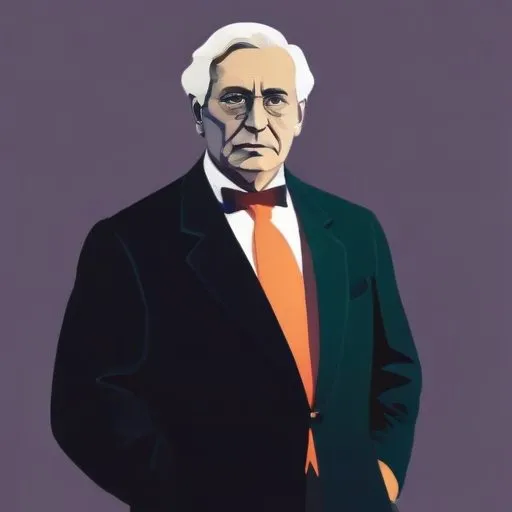
A Canadian lawyer and politician who played a key role in the Lower Canada Rebellion of 1837-1838, advocating for democratic reforms and responsible government.
Louis-Joseph Papineau was a prominent Canadian politician, lawyer, and landlord who led the reformist Patriote movement in Lower Canada (now Quebec) during the 19th century. He is best known for his advocacy for democratic reforms, responsible government, and French-Canadian rights, which culminated in the Rebellion of 1837-1838.
Born on October 7, 1786, in Montreal, Quebec, Papineau was the eldest of eight children to Joseph Papineau, a politician and landlord. He was described as an energetic child and pursued his education at the Collège Saint-Raphaël in Montreal and later at the Petit Séminaire de Québec.
Papineau began his law career as an apprentice under his father and cousin Denis-Benjamin Viger. In 1810, he was admitted to the Bar of Lower Canada and later served as a militia officer during the War of 1812. His entry into politics began in 1808, when he was elected member of parliament for Kent (now Chambly), Quebec.
Papineau's leadership and oratory skills earned him recognition as a champion of French-Canadian rights and a strong advocate for democratic reforms. He became the leader of the Patriote movement, which sought to challenge the authority of the British colonial government and promote responsible government. In 1822, he traveled to London with John Neilson to present a petition of 60,000 signatures against the Union project, which aimed to merge Upper and Lower Canada.
The Patriote movement's demands for reform were met with resistance from the British government, leading to the Rebellion of 1837-1838. Papineau played a key role in the rebellion, which ultimately failed to achieve its goals. He was forced into exile in the United States and France, where he remained until 1845.
Despite the failure of the rebellion, Papineau's legacy as a champion of democracy and French-Canadian rights has endured. He is remembered as a key figure in the development of Canadian politics and a symbol of the struggle for responsible government. His grandson, Henri Bourassa, went on to become a prominent journalist and founder of the newspaper Le Devoir.
Papineau married Julie Bruneau in 1810 and had several children. He inherited the seigneurie de la Petite-Nation from his father and managed it until his death on September 23, 1871. Throughout his life, Papineau was known for his strong personality, eloquence, and commitment to his principles.
Louis-Joseph Papineau's life and legacy are deeply rooted in the history of Quebec and Canada. His struggle for democratic reforms and French-Canadian rights continues to inspire generations of Canadians. His legacy serves as a reminder of the importance of responsible government, democratic participation, and the struggle for human rights.
Born in 1919
The charismatic leader who championed Canadian unity and implemented progressive policies, known for his iconic style and influential legacy in shaping modern Canada.
92 Years Old
The 20th Prime Minister of Canada, serving from 1993 to 2003, known for his leadership during the Quebec sovereignty movement and his role in shaping Canada's national unity. He implemented policies like the Clarity Act and the National Child Benefit.
45 Years Old
American professional ice hockey player who won two Stanley Cup championships and was a four-time NHL All-Star. Known for his rugged defensive play and physical presence on the ice.
Born in 1897
A Canadian leader who served as Prime Minister and won the Nobel Peace Prize for resolving the Suez Canal Crisis, known for his diplomatic efforts and peacekeeping initiatives.
Born in 1815
The first Prime Minister of Canada, a key figure in the country's formation and development, known for shaping its early years and creating a unified nation.
Born in 1841
The 7th Prime Minister of Canada, a champion of national unity and French-English relations, who navigated the country through significant industrial and economic growth. He's also known for his role in shaping Canada's autonomy from Britain.
Born in 1874
The tenth Prime Minister of Canada, serving for a record 22 years, is most known for leading the country through significant periods of economic and social change, including the Great Depression and World War II.
