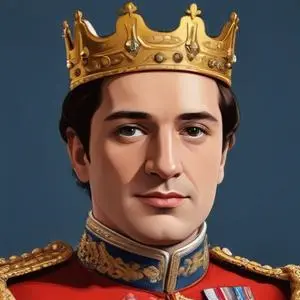
Louis Philippe I: The Citizen King of France
The King Who Ruled with a Gentle Hand
Louis Philippe I, also known as the Citizen King, was the King of the French from 1830 to 1848, and one of the most influential monarchs in French history. He is best known for his role in shaping the July Monarchy, a period of relative peace and prosperity in France, and for his conservative policies that promoted industrialization and colonial expansion.
A Turbulent Early Life
Born on October 6, 1773, in the Palais-Royal, Paris, Louis Philippe was the son of
Louis Philippe II, Duke of Orléans, and was destined for greatness. However, his early life was marked by turmoil and uncertainty. During the French Revolutionary Wars, he distinguished himself as a skilled military commander, earning the rank of lieutenant general by the age of 19. But when the Revolution turned radical, Louis Philippe broke with the Republic over its decision to execute King Louis XVI, and he fled to Switzerland in 1793.
Exile and Restoration
For 21 years, Louis Philippe remained in exile, waiting for the Bourbon Restoration to take place. During this time, his father, Louis Philippe II, was executed during the Reign of Terror, and Louis Philippe himself faced financial struggles and personal hardship. However, with the fall of
Napoleon Bonaparte in 1814, Louis Philippe was finally able to return to France and reclaim his title as Duke of Orléans.
The July Monarchy
In 1830, Louis Philippe's cousin, Charles X, was forced to abdicate after the July Revolution, and Louis Philippe was proclaimed king. This marked the beginning of the July Monarchy, a period characterized by relative peace and prosperity in France. Louis Philippe's reign was marked by conservative policies, which promoted industrialization, banking, and colonial expansion. He also fostered close relationships with European powers, particularly Great Britain.
A Policy of Colonization
One of Louis Philippe's most significant legacies was his colonization of Algeria, which began in 1830. This move marked a significant shift in French foreign policy, as the country began to expand its territories beyond Europe. Louis Philippe's colonial ambitions also led to the establishment of colonies in Africa and Asia.
Family and Personal Life
Louis Philippe was married to Queen Marie-Amélie de Bourbon, and they had nine children together. His grandchildren would go on to become monarchs in their own right, including
Leopold II of Belgium, Empress
Carlota of Mexico,
Ferdinand I of Bulgaria, and Queen Mercedes of Spain.
Legacy and Abdication
Despite his many achievements, Louis Philippe's popularity began to wane in the late 1840s, as economic conditions in France began to deteriorate. On February 24, 1848, he was forced to abdicate, marking the end of the July Monarchy and the beginning of the Second Republic. Louis Philippe spent the remainder of his life in exile in the United Kingdom, where he died on August 26, 1850.
Quotes and Memorabilia
- "I will always be the king of the French, but I am also the king of the people." - Louis Philippe I
- Louis Philippe's royal standard, which featured a fleur-de-lis and a tricolor, became a symbol of the July Monarchy.
Fun Facts
- Louis Philippe was known for his love of horses and was an accomplished equestrian.
- He was the first French monarch to visit Great Britain while still in power.
Historical Context and Legacy
Louis Philippe's reign marked a significant turning point in French history, as the country transitioned from a revolutionary era to a more stable, monarchical period. His conservative policies and colonial ambitions shaped the course of French history, and his legacy continues to be felt today. Despite his eventual abdication, Louis Philippe remains one of the most important and influential monarchs in French history.
FAQ
How did Louis Philippe I become King of France?
Louis Philippe I became King of France in 1830, following the July Revolution, which deposed King Charles X. He was chosen as king due to his moderate politics and his reputation as a liberal.
What were Louis Philippe Is major reforms?
Louis Philippe I implemented several major reforms, including the expansion of voting rights, the establishment of a constitutional monarchy, and the modernization of the French education system.
How did Louis Philippe I respond to the February Revolution?
Louis Philippe I was forced to abdicate during the February Revolution of 1848, which led to the establishment of the Second Republic. He went into exile in England, where he died in 1850.
What was Louis Philippe Is relationship with Napoleon?
Louis Philippe I was a vocal opponent of Napoleon Bonaparte and the Napoleonic Empire. He was a strong supporter of the Bourbon monarchy and played a key role in the Restoration of 1814.
What is Louis Philippe Is legacy in French history?
Louis Philippe Is legacy in French history is complex, with some viewing him as a reformer who modernized France, while others see him as a weak leader who failed to address the social and economic issues of his time.