


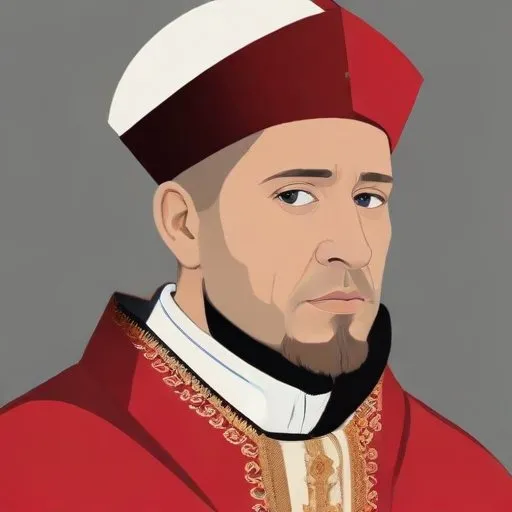
A 15th-century Polish bishop who played a key role in the Polish Renaissance, supporting education and arts, and was a patron of Copernicus. He governed Warmia, a region in northern Poland, and was a skilled diplomat.
Lucas Watzenrode, the Younger, was a German prince-bishop who left an indelible mark on the world of astronomy. As the patron and uncle of the renowned astronomer Nicolaus Copernicus, Watzenrode played a pivotal role in nurturing the young Copernicus's talent, setting him on a path that would revolutionize our understanding of the universe.
Born on October 30, 1447, in Thorn, Toruń, Poland, Lucas Watzenrode was the son of the merchant Lucas Watzenrode the Elder. His family's roots stemmed from the Silesian village of Weizenrodau and Romeo, now Pszenno. After his sister Barbara and her husband Niklas Koppernigk passed away circa 1483, Watzenrode took on the responsibility of caring for their four children, including the young Nicolaus Copernicus.
Watzenrode's education at Jagiellonian University, as well as the universities of Cologne and Bologna, prepared him for a life of leadership. He became the Prince-Bishop of Warmia Ermland in 1489, an appointment that was met with resistance from King Casimir IV Jagiellon, who had preferred his own son, Frederic, for the position. Watzenrode's determination and diplomatic prowess ultimately secured his position, allowing him to establish the exemption of the Bishopric of Warmia.
As a patron and uncle to Nicolaus Copernicus, Watzenrode recognized and nurtured the young astronomer's talent. He facilitated Copernicus's education, providing him with access to the best universities and connecting him with influential scholars. Copernicus would later go on to propose the heliocentric model, which placed the Sun at the center of our solar system, rather than the Earth.
The Bishopric of Warmia, previously part of the Monastic State of the Teutonic Knights, had come under the protection of the King of Poland with the Second Peace of Thorn in 1466. This treaty granted the Polish King the right to appoint the Bishop, leading to a complex web of power struggles and disputes. Watzenrode's appointment as Prince-Bishop marked a significant shift in the balance of power, cementing his legacy as a shrewd statesman and leader.
Watzenrode's patronage of Nicolaus Copernicus not only facilitated the development of the heliocentric model but also paved the way for future scientific breakthroughs. The ripple effects of Watzenrode's support can be seen in the works of Galileo Galilei, Johannes Kepler, and Isaac Newton, who built upon Copernicus's foundation to shape our modern understanding of the universe.
Lucas Watzenrode's remarkable life serves as a testament to the power of vision, perseverance, and patronage. As we gaze up at the stars, we remember the prince-bishop who dared to challenge the status quo and empower the next generation of thinkers, forever changing the course of human understanding.
Born in 1473
A Renaissance-era mathematician and astronomer who proposed the heliocentric model, where the Sun is at the center of our solar system, revolutionizing our understanding of the universe.
Born in 1480
A 16th-century Polish bishop who played a key role in the Protestant Reformation, advocating for Church reform and supporting prominent figures like Martin Luther. He's also known for his diplomatic efforts to unite European Protestant leaders.
