


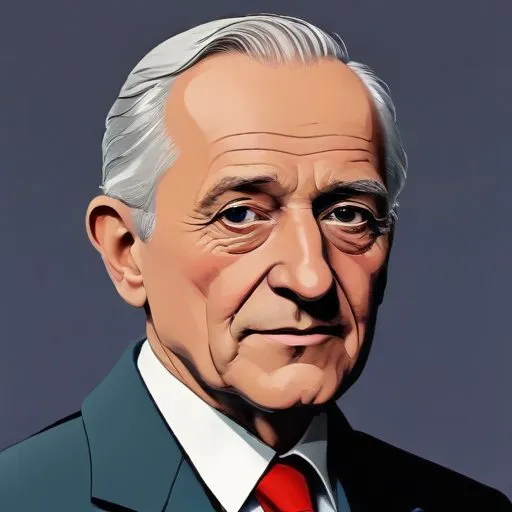
A German pacifist and politician who advocated for international cooperation and disarmament, earning him the Nobel Peace Prize in 1927. He played a key role in promoting peace and reconciliation in post-WWI Europe.
Ludwig Quidde, a German politician and pacifist, is best known for his unwavering criticism of German Emperor Wilhelm II. His bravery in speaking out against the monarch's policies earned him the Nobel Peace Prize in 1927.
Born on March 23, 1858, in the Free City of Bremen, Quidde was raised in a wealthy bourgeois merchant family. His inheritance allowed him to devote himself to politics, and he went on to study history at the University of Göttingen, where he received his PhD in 1881.
Quidde's opposition to Otto von Bismarck's policies was evident from an early age. In 1893, he joined the German People's Party, which aligned with his democratic and pacifist beliefs. However, it was his 1894 pamphlet, Caligula. Eine Studie über römischen Caesarenwahnsinn, that truly showcased his fearlessness. The 17-page treatise drew a parallel between the Roman Emperor Caligula and Wilhelm II, accusing both of megalomania. The publication effectively ended Quidde's academic career as a historian.
Quidde's criticism of Wilhelm II did not go unnoticed. He was criminally convicted of lèse-majesté and sentenced to three months in prison for making a derogatory comment about a new medal in honor of Wilhelm I, German Emperor. Quidde served his sentence in Stadelheim Prison.
Throughout his life, Quidde dedicated himself to the cause of peace. He was an active member of the German Peace Society and worked tirelessly to promote international understanding and cooperation. His efforts were recognized in 1927 when he was awarded the Nobel Peace Prize.
Ludwig Quidde's legacy extends beyond his criticism of Wilhelm II. He was a devoted pacifist who fought for democracy and human rights. His bravery in the face of adversity serves as an inspiration to generations. Quidde passed away on March 4, 1941, in Geneva, Switzerland, leaving behind a testament to the power of standing up for one's convictions.
Born in 1843
A pioneering pacifist and writer, she championed international disarmament and peace, earning the first Nobel Peace Prize awarded to a woman. Her groundbreaking work inspired a generation of peace activists.
Born in 1833
A Swedish chemist and engineer who invented dynamite and established a prestigious award recognizing outstanding contributions in fields like literature, peace, and science.
Born in 1828
Co-founder of the Red Cross, a humanitarian organization providing aid in war zones and natural disasters, and a Nobel Peace Prize winner for his efforts. He pioneered the concept of international humanitarian law.
Born in 1822
A French economist and academic who was awarded the Nobel Peace Prize in 1901 for his efforts to establish the International Committee of the Red Cross and promote international arbitration. He is known for his pioneering work in promoting peace and conflict resolution.
Born in 1833
A pioneering pacifist and women's rights advocate, she dedicated her life to promoting international peace and unity, earning her the Nobel Peace Prize in 1902.
Born in 1843
A Swiss lawyer and politician who worked tirelessly to promote international arbitration and peace, earning him the Nobel Peace Prize in 1902. He's most known for his efforts to establish the International Committee of the Red Cross.
Born in 1860
A pioneering social worker and peace activist, she founded Hull House, a settlement that provided social services to immigrants and the working poor, and was awarded the Nobel Peace Prize in 1931.
Born in 1862
A renowned philosopher and educator, he was a leading figure in the development of American education and international relations, and was awarded the Nobel Peace Prize in 1931.
