


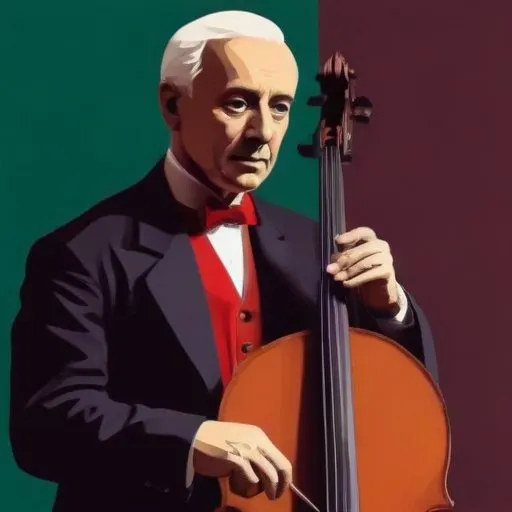
A renowned Italian cellist and composer, known for his contributions to the classical music repertoire, particularly his iconic "Minuet" from String Quintet in E major, Op. 11, No. 5.
Luigi Boccherini is best known for his captivating minuet from his String Quintet in E, Op. 11, No. 5, G 275, a piece that has become synonymous with elegance and refinement. His Cello Concerto in B-flat major, G 482, is another masterpiece that showcases his mastery of the instrument, and his contribution to the world of classical music.
Boccherini was born into a musical family in Lucca, Italy on February 19, 1743. His father, Leopoldo Boccherini, was a cellist and double-bass player who taught Luigi his first music lessons at the tender age of five. This early start laid the foundation for Boccherini's future success.
In 1757, Boccherini and his father moved to Vienna, where they were employed as musicians in the Burgtheater. This opportunity provided Boccherini with valuable exposure and experience, which he leveraged to further his career. In 1768, he journeyed to Madrid, where he entered the employ of Infante Luis Antonio of Spain, a patron who recognized his exceptional talent.
During his time in Madrid, Boccherini's music flourished under royal patronage. However, a disagreement with the King of Spain led to his sudden dismissal. The King had expressed his disapproval of a passage in one of Boccherini's trios, and the composer, feeling affronted, chose to double the passage instead of making the requested changes. This bold move resulted in his abrupt departure from the royal court.
Boccherini's music is characterized by its courtly and galante style, which reflects his experience as a court musician. He composed numerous string quartets, quintets, and concertos, as well as guitar quintets that showcased his versatility. One of his most famous works, the Guitar Quintet No. 4 in D, G 448, features a lively fandango, a traditional Spanish dance.
For a long time, Boccherini's music was known primarily through the heavily altered versions by Friedrich Grützmacher, a German cellist and arranger. However, in recent years, efforts have been made to restore his original scores, allowing modern audiences to appreciate the composer's true artistic vision.
Boccherini's music has had a lasting impact on classical music, influencing composers such as Haydn and Mozart. His contribution to the development of the cello concerto repertoire is significant, and his elegant style continues to inspire modern composers and musicians.
Luigi Boccherini's legacy continues to captivate audiences with its beauty, elegance, and sophistication. Through his music, he has left an indelible mark on the world of classical music, ensuring his place as one of the most celebrated composers of the Classical era.
Born in 1732
A renowned composer and pianist of the Classical period, known for his symphonies, operas, and chamber music that showcased his innovative and expressive style. He played a significant role in shaping the Classical music era.
Born in 1756
A child prodigy and master of classical music, he composed over 600 works, including symphonies, operas, and chamber music, that continue to inspire and influence musicians today.
Born in 1770
A musical genius who expanded the possibilities of classical music, creating iconic symphonies and piano sonatas that continue to inspire and influence generations of artists.
Born in 1782
A virtuosic violinist and composer who revolutionized the instrument's technical possibilities, leaving an indelible mark on classical music.
Born in 1755
A virtuosic violinist and prolific composer, he wrote over 30 violin concertos and influenced the development of the classical violin concerto. His music is still performed and admired today.
Born in 1752
A renowned pianist, composer, and conductor who revolutionized piano music with his technically demanding and expressive compositions, influencing generations of musicians.
Born in 1749
An 18th-century Italian composer and educator, known for his operas and sacred music, particularly his comic operas that showcased his mastery of melody and harmony.
Born in 1714
A pioneering opera composer who revolutionized the art form with his innovative and expressive works, blending music and drama in a way that captivated audiences.
