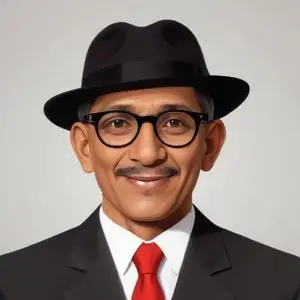
M. Visvesvaraya

M. Visvesvaraya

M. Visvesvaraya was born on September 15th, 1861

Full Name: Mokshagundam Visvesvaraya
Birthplace: Muddenahalli, India
Occupation: Engineer, Scholar, and Bharat Ratna Laureate
Nationality: Indian
Notable Work: Designing of Krishna Raja Sagara dam
Birth Date: September 15, 1860
Death Date: April 12, 1962
Awards: Bharat Ratna

A renowned Indian engineer, scholar, and statesman who played a crucial role in the development of India's infrastructure and industry, earning him the country's highest civilian honor. He is most known for his innovative irrigation systems and hydroelectric projects.

Timeline
1861
Born in Muddenahalli, India
M. Visvesvaraya was born on September 15, 1861, in Muddenahalli, India, to a family of modest means.
1883
Graduated from the College of Engineering
Visvesvaraya graduated from the College of Engineering in Pune, India, and began his career as an engineer.
1909
Designed the Krishna Raja Sagara Dam
Visvesvaraya designed the Krishna Raja Sagara Dam, a major irrigation project in Mysore, India.
1913
Served as Diwan of Mysore
Visvesvaraya served as the Diwan of Mysore, overseeing the administration of the kingdom.
1962
Died in Bangalore, India
M. Visvesvaraya died on April 12, 1962, in Bangalore, India.
M. Visvesvaraya

M. Visvesvaraya Quiz

M. Visvesvaraya is most known for his innovative work in which field?

Score: 0/5
FAQ
What was M. Visvesvarayas contribution to engineering?
M. Visvesvaraya was an Indian engineer and scholar who made significant contributions to the development of irrigation systems, dams, and bridges in India.
How did M. Visvesvaraya become interested in engineering?
M. Visvesvaraya was born in 1861 in Karnataka, India. He studied at the College of Engineering in Pune and later at the University of Bombay.
What were M. Visvesvarayas achievements in irrigation engineering?
M. Visvesvaraya designed and implemented several irrigation projects, including the Krishna Raja Sagara dam in Mysore. He also introduced new technologies to India, such as the use of steel in bridge construction.
What honors did M. Visvesvaraya receive?
M. Visvesvaraya was awarded the Bharat Ratna, Indias highest civilian honor, in 1955. He also received honorary degrees from several universities and was a fellow of the Indian Institute of Science.
What was M. Visvesvarayas legacy?
M. Visvesvarayas legacy is that of a visionary engineer who transformed Indias infrastructure and inspired generations of engineers and scientists.

Related People:

C. Rajagopalachari

Born in 1878

The first Indian Governor-General of India, serving from 1948 to 1950, and a key figure in the country's struggle for independence from British rule. He was a strong advocate for non-violent resistance and played a crucial role in shaping India's early years.

Jawaharlal Nehru

Born in 1889

India's first Prime Minister, a key figure in the country's struggle for independence from British rule, and a champion of democracy and secularism. He played a crucial role in shaping modern India's government and economy.

Rajendra Prasad

Born in 1884

India's first president, a key figure in the country's struggle for independence, who played a crucial role in shaping the nation's early years. He's revered for his leadership and commitment to democracy.

Sarojini Naidu

Born in 1879

A pioneering Indian poet and activist who used her lyrical voice to advocate for women's rights and Indian independence, leaving a lasting legacy in Indian literature and politics.

Mahatma Gandhi

Born in 1869

Indian freedom fighter, activist, and philosopher who led India to independence from British rule through non-violent civil disobedience, inspiring civil rights movements worldwide.

B. R. Ambedkar

Born in 1891

Indian Minister of Law and Justice who fought for the rights of the marginalized and drafted the Indian Constitution, playing a key role in shaping modern India's democracy.

Vallabhbhai Patel

Born in 1875

Indian lawyer and politician who played a key role in India's struggle for independence and later became the country's first Deputy Prime Minister, known for his strong leadership and unification of the country.

Morarji Desai

Born in 1896

Fourth Prime Minister of India, known for his efforts to decentralize power and promote economic development, and for being the first Indian Prime Minister to resign from office.