


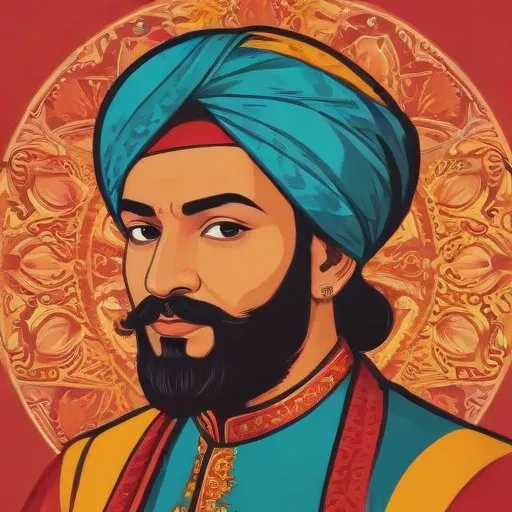
A Mughal noble and governor of Bengal, known for his military campaigns and administrative skills, which helped expand the Mughal Empire.
Man Singh I, the 24th Maharaja of Amber, is renowned for his unwavering loyalty to the Mughal Empire and his impressive military prowess, having fought in 67 significant battles across Kabul, Balkh, Bukhara, Bengal, and Central and Southern India. He is also celebrated as one of the Navaratnas, or the nine gems of the royal court of Emperor Akbar.
Born on December 21, 1550, Man Singh was the son of Raja Bhagwant Das and his wife Bhagawati of Amer. Initially known as Kunwar (prince), he received the title of Mirza or Raja and the rank of 5000 after the death of his father in 1589 from Akbar. This recognition marked the beginning of his illustrious career in the Mughal Army.
Man Singh's military prowess was unparalleled, and he fought alongside Emperor Akbar in numerous campaigns. One of his most notable achievements was his victory in the Battle of Haldighati in 1576 against the Kingdom of Mewar. He led the Mughal Army with precision and skill, earning the respect of his enemies and the admiration of his peers.
Man Singh's cultural contributions are just as remarkable as his military conquests. He is credited with the reestablishment of the revered Jagannath Temple in Puri, Orissa, and the construction of the sacred Kashi Vishwanath Temple in Varanasi. These architectural marvels continue to inspire awe and devotion in people to this day.
In 1576, Man Singh was sent by Akbar to Maharana Pratap to negotiate a treaty and secure Mughal sovereignty over Mewar. Although Pratap refused, leading to the Battle of Haldighati, Man Singh's diplomatic efforts demonstrate his ability to navigate complex political situations and prioritize the interests of the Mughal Empire.
Man Singh's legacy extends beyond his military victories and architectural achievements. He embodied the values of loyalty, courage, and strategic thinking, earning him a place among the esteemed Navaratnas of Akbar's court. His influence can be seen in the Mughal Empire's expansion and consolidation of power during his lifetime.
In conclusion, Man Singh I's remarkable life is a testament to his unwavering dedication to the Mughal Empire and his unrelenting pursuit of excellence in battle and beyond. His legacy continues to inspire generations, serving as a reminder of the importance of loyalty, courage, and strategic thinking in the pursuit of greatness.
Born in 1569
The fourth Mughal emperor, known for his tolerant and artistic reign, patronizing arts and architecture, and expanding the empire through strategic military campaigns.
Born in 1592
The fifth Mughal emperor, who built the iconic Taj Mahal as a mausoleum for his beloved wife, and expanded the empire through military campaigns and architectural achievements.
Born in 1618
The Mughal emperor who ruled India from 1658 to 1707, expanding the empire to its greatest extent and implementing Islamic law, while also being known for his architectural achievements, including the Badshahi Mosque.
Born in 1615
The eldest son of Mughal Emperor Shah Jahan, a philosopher and translator who sought to find common ground between Islam and Hinduism, and translated many Hindu texts into Persian. He was a symbol of religious tolerance and harmony in 17th-century India.
Born in 1666
A spiritual leader who founded the Sikh warrior community and wrote poetic compositions that are still revered today, known for his bravery and spiritual guidance.
