


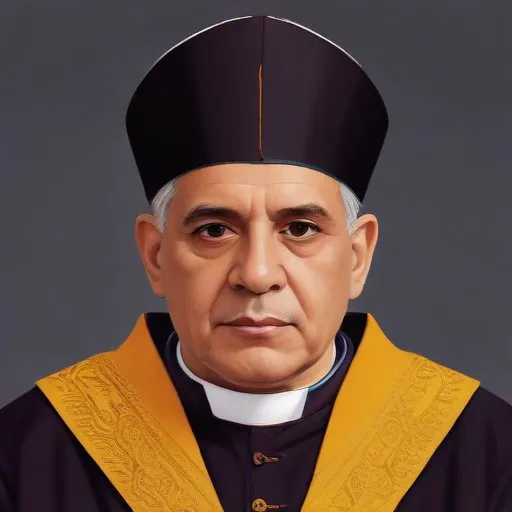
A Spanish-born Mexican bishop who played a key role in Mexico's independence movement and was a strong advocate for education and social reform. He also founded several institutions, including a seminary and a newspaper.
Manuel Abad y Queipo, a Spanish Roman Catholic Bishop of Michoacán, is renowned for his acute social commentary on late colonial Mexico and his exemplary display of enlightenment as a clergyman. His bold views on the Mexican War of Independence and his advocacy for the indigenous people of New Spain cement his legacy as a champion of justice and equality.
Born out of wedlock to an Asturian nobleman on August 26, 1751, in Santa Maria de Villarpedre, Abad y Queipo defied convention to pursue a life of service. He obtained his baccalaureate in law and canon law from the University of Salamanca, followed by his ordination as a priest in Guatemala. His early career took him to Valladolid (now Morelia), where he served as a judge in a canon law court, gaining invaluable insight into church wealth and credit.
Abad y Queipo's academic prowess earned him a doctorate in canon law from the University of Guadalajara in 1805. In 1810, he was nominated as Bishop-elect of Michoacán, although the pontifical bull confirming his position never arrived. Undeterred, he traveled to Spain to seek habilitation, due to his illegitimate birth, which prohibited his promotion to higher ecclesiastical ranks. He returned to New Spain as vicar general, later taking over the diocese before the arrival of the pontifical bull.
Abad y Queipo's love for New Spain shone brightly, as he declared himself an American by voluntary adoption. He passionately advocated for New Spain's autonomy within the Spanish empire, emphasizing the equal rights of Mexico's indigenous people. His conviction led him to take bold stances, often at odds with the Spanish crown.
Abad y Queipo's unwavering commitment to social justice and his unshakeable faith have left an indelible mark on Mexican history. As a champion of the marginalized, his legacy inspires future generations to fight for equality and human rights. Through his writings and teachings, he continues to enlighten and inspire, cementing his place as one of the most influential figures of his time.
Abad y Queipo's philosophical contributions centered around the concept of equality and justice. He firmly believed that the indigenous people of New Spain were entitled to the same rights and dignity as their Spanish counterparts. His advocacy for education and social reform reflected his conviction that knowledge and empowerment were essential for the betterment of society.
Through his remarkable life, Manuel Abad y Queipo demonstrated an unwavering commitment to social justice, education, and equality. His legacy serves as a beacon of hope, inspiring future generations to strive for a more just and equitable society.
Born in 1499
Reigned from 1559 to 1565, this Pope oversaw the final session of the Council of Trent, shaping Catholic doctrine and practice for centuries to come. He also commissioned the construction of the Sistine Chapel's dome.
Born in 1810
The first pope to fully embrace modernity, he issued the groundbreaking encyclical Rerum Novarum, which addressed social justice and workers' rights, shaping the Catholic Church's stance on social issues.
Born in 1794
A charismatic and cunning leader who dominated Mexican politics for decades, known for his role in the Texas Revolution and multiple presidential terms.
Born in 1753
A Mexican priest who sparked the country's war for independence from Spain with his famous "Grito de Dolores" cry for freedom, leading a rebellion against colonial rule.
Born in 1783
Mexican royalist turned insurgent who led the country to independence and became its first emperor, known for uniting the country and establishing the Mexican Empire. He played a crucial role in shaping Mexico's early history.
Born in 1786
Led Mexico's war for independence from Spain, becoming the country's first president and establishing its democratic government. He's revered as a national hero and symbol of Mexican independence.
Born in 1806
A champion of democracy and indigenous rights, he modernized Mexico, abolished slavery, and limited church power. He's revered as a national hero for his progressive reforms.
Born in 1830
A Mexican general and politician who ruled Mexico with an iron fist from 1876 to 1911, modernizing the country while suppressing dissent and opposition. He's infamous for his authoritarian regime and eventual exile.
