


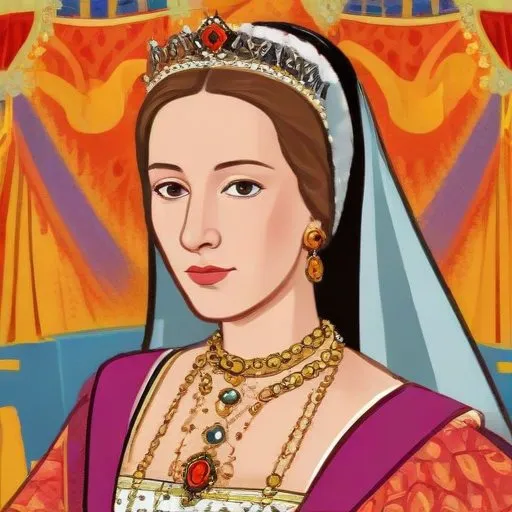
Governor of the Habsburg Netherlands, she played a key role in European politics and diplomacy during the 16th century, known for her wise and effective governance.
Known for her influential reign as Queen of Spain and Portugal, Margaret of Austria was a devoted patron of the arts, a shrewd politician, and a passionate advocate for Catholic Europe. Married to King Philip III of Spain, her first cousin, Margaret played a crucial role in shaping the kingdom's politics and cultural landscape.
Born on December 25, 1584, Margaret was the daughter of Archduke Charles II of Austria and Maria Anna of Bavaria. Through her paternal lineage, she was the granddaughter of the Holy Roman Emperor Ferdinand I. Her elder brother, Archduke Ferdinand, would later become Emperor in 1619, while her sisters, Anna and Constance, would become Queens of Poland through their marriages to King Sigismund III Vasa.
Margaret married King Philip III of Spain on April 18, 1599, solidifying her position as a central figure in the Spanish court. Her husband held her in high esteem, and her influence grew significantly after the birth of their son in 1605. As a skilled politician, Margaret worked tirelessly to promote the interests of Catholic Europe, often finding herself at odds with the Duke of Lerma, the King's chief minister, who advocated for Spain's independence from religious and dynastic ties.
In addition to her own influence, Margaret formed a circle of powerful women, including the Empress Maria, widow of Holy Roman Emperor Maximilian II, and Archduchess Margaret, who lived as a nun in Madrid. Together, they wielded considerable power over King Philip, emphasizing Spain's role as a Catholic power and highlighting the unity of the House of Habsburg.
Margaret was a devoted patron of the arts, fostering a culture of creativity and innovation in the Spanish court. Her love for architecture was reflected in the construction of various buildings, including the Royal Palace of Madrid, which became a symbol of Spanish grandeur.
Despite her many achievements, Margaret's life was not without controversy. She was known to be melancholic and unhappy about the influence of the Duke of Lerma over her husband, leading to a series of power struggles that would shape the course of Spanish politics.
Margaret of Austria, Queen of Spain, left an indelible mark on European history, cementing the Habsburg dynasty's position as a dominant force in Catholic Europe. Her legacy serves as a testament to the power and influence of women in politics, art, and architecture during the 17th century.
Remembering Margaret of Austria, Queen of Spain, we are reminded of the complex web of alliances, rivalries, and cultural exchange that defined early modern Europe. Her story serves as a fascinating chapter in the broader narrative of the Habsburg dynasty's rise to prominence.
Born in 1500
Ruling over a vast empire from 1519 to 1556, he was a powerful and influential leader who played a crucial role in shaping European politics and religion. He is most known for his efforts to unify Christian Europe and defend it against the Ottoman Empire.
Born in 1503
The first Habsburg to rule the Holy Roman Empire, he unified Austria and introduced the concept of a hereditary monarchy, shaping European politics for centuries to come.
Born in 1451
Unified the Spanish kingdoms, sponsored Christopher Columbus's voyage to the Americas, and established the Spanish Inquisition.
Born in 1380
Unified the Crown of Aragon, ruling over a vast territory in eastern Spain, and sponsored the voyages of Christopher Columbus, leading to the discovery of the New World.
Born in 1485
Spanish princess who became the queen consort of England, playing a central role in the English Reformation and sparking the creation of the Church of England.
Born in 1516
The first queen to rule England in her own right, Bloody Mary tried to restore Catholicism, earning her notorious reputation for burning hundreds of Protestants at the stake.
Born in 1533
The Virgin Queen, a powerful and beloved monarch, ruled England during a golden age of culture, literature, and exploration, establishing the Church of England and defeating the Spanish Armada.
