


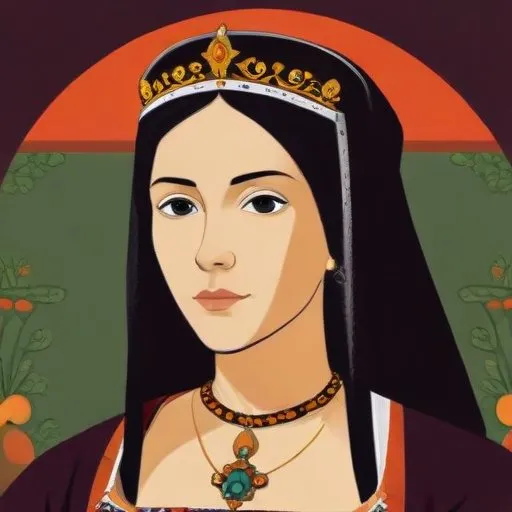
The wife of King Manuel I of Portugal, she played a crucial role in strengthening ties between Portugal and Spain, and was a patron of the arts and education.
Maria of Aragon, Queen of Portugal, is remembered as the second wife of King Manuel I and a pivotal figure in solidifying the dynastic ties between the Spanish and Portuguese royal houses. As the Queen of Portugal from 1500 until her death in 1517, she played a crucial role in shaping the country's politics, culture, and society.
Born on June 29, 1482, in Córdoba, Spain, Maria was the third surviving daughter of Isabella I of Castile and Ferdinand II of Aragon, the renowned Catholic monarchs. As a princess of the Spanish royal family, she received a comprehensive education, which included arithmetic, Latin, languages, history, philosophy, and the classics, in addition to household tasks.
Maria's hand in marriage was a valuable asset in European politics. Before marrying King Manuel I of Portugal, her parents considered marrying her to King James IV of Scotland, with the goal of maintaining peace between the two kingdoms. However, this plan was eventually abandoned. After the death of her elder sister, Isabella, Princess of Asturias, Maria became the next bride of King Manuel I, reaffirming the dynastic links between the Iberian royal houses.
Maria and Manuel I were married on October 30, 1500, in Alcácer do Sal, Portugal. As queen, she was granted Viseu and Torres Vedras as her dower. During her reign, she gave birth to 10 children, eight of whom reached adulthood, including notable figures such as King John III of Portugal, Holy Roman Empress Isabella, and Beatrice, Duchess of Savoy.
Contemporary accounts describe Maria as pale and thin, with a retiring chin, and possessing a serious character. Despite being queen during a significant period in Portuguese history, her reserved nature often overshadowed her achievements. Nevertheless, her legacy as a devoted wife, mother, and queen remains an essential part of Portugal's royal heritage.
Maria's reign coincided with the Portuguese Age of Exploration, during which her husband, King Manuel I, sponsored numerous expeditions that expanded Portugal's empire. As queen, she played a supporting role in these endeavors, not only through her marriage but also as a symbol of the royal family's commitment to the nation's ambitions.
In conclusion, Maria of Aragon, Queen of Portugal, was a vital figure in the Iberian Peninsula's royal landscape, whose marriage to King Manuel I and her role as queen helped shape the course of Portuguese history. Her legacy as a devoted wife, mother, and queen continues to inspire and fascinate historians and scholars today.
Born in 1469
King of Portugal from 1495 to 1521, known for sponsoring Vasco da Gama's voyage to India, establishing trade routes, and promoting the Portuguese Renaissance.
Born in 1455
King of Portugal from 1481 to 1495, known for his centralizing policies, establishing a strong monarchy, and sponsoring explorers like Bartolomeu Dias and Vasco da Gama.
Born in 1554
The last monarch of the House of Aviz, who disappeared during a crusade in Morocco, leading to a succession crisis that changed the course of Portuguese history. He's a legendary figure, symbolizing a lost golden age.
Born in 1498
Queen of Portugal and France, known for her strong diplomatic skills and strategic marriages that shaped European politics. She played a key role in maintaining peace and alliances between nations.
Born in 1380
Unified the Crown of Aragon, ruling over a vast territory in eastern Spain, and sponsored the voyages of Christopher Columbus, leading to the discovery of the New World.
Born in 1451
Unified the Spanish kingdoms, sponsored Christopher Columbus's voyage to the Americas, and established the Spanish Inquisition.
