


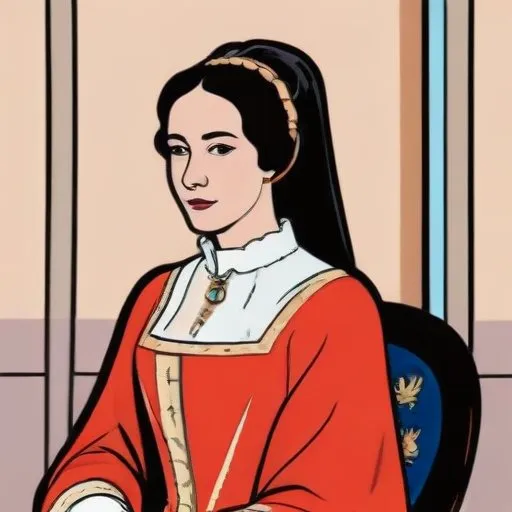
A French noblewoman who played a significant role in the French Wars of Religion, known for her strong will and strategic marriages that shaped the course of French history.
Marie d'Albret, Countess of Rethel, was a powerful and influential woman of the French nobility, known for her impressive lineage, strategic marriages, and remarkable reign as the suo jure Countess of Rethel. Her life was marked by a series of significant events, alliances, and family connections that shaped the course of European history.
Marie was born on March 25, 1491, at the Château de Cuffy in France, to Jean d'Albret, Sire of Orval, and Charlotte of Nevers, Countess of Rethel. At the tender age of nine, she inherited the title of Countess of Rethel upon the death of her mother, making her one of the most powerful women in the region.
On January 25, 1504, Marie married Charles II of Cleves, Count of Nevers, a strategic union that strengthened her position and expanded her influence. This marriage produced a son, Francis I of Cleves, who would go on to become the 1st Duke of Nevers and Count of Rethel.
Marie's family was marked by a complex web of alliances and relationships. Her paternal great-great-grandfather, Charles d'Albret, was the Constable of France, who fought and died at the Battle of Agincourt in 1415. Her maternal grandparents were John II, Count of Nevers, and Pauline de Bosse-Bretagne.
Marie's life was not without controversy. She had two illegitimate half-siblings, Jacques d'Albret, Bishop of Nevers, and Françoise d'Albret, Abbess of Notre Dame de Nevers. Her sister, Hélène d'Albret, died at the age of 24, leaving behind a legacy of mystery and intrigue.
Marie d'Albret, Countess of Rethel, left an indelible mark on European history. Her strategic marriages, alliances, and inheritance paved the way for future generations of nobility. Her legacy serves as a testament to the power and influence of women in the medieval period.
Through her remarkable life and reign, Marie d'Albret, Countess of Rethel, left an enduring legacy that continues to captivate and inspire us to this day.
Born in 1519
King of France from 1547 to 1559, known for his cultural and artistic patronage, and his role in the Italian Wars.
Born in 1575
The Queen of France who commissioned the Luxembourg Palace and was the subject of Peter Paul Rubens' famous cycle of paintings, known for her extravagant lifestyle and political influence.
Born in 1785
The last king of the French monarchy before the French Revolution, known for his tragic and mysterious life, including his imprisonment and disputed death.
Born in 1601
The queen who ruled France alongside her son Louis XIV, known as the Sun King, and played a significant role in shaping the country's politics and culture during the 17th century. She was a skilled diplomat and strategist who helped to establish France as a dominant European power.
Born in 1585
A powerful and cunning statesman who dominated French politics during the 17th century, known for his ruthless suppression of dissent and centralization of power. He was a master strategist and diplomat who shaped the course of European history.
Born in 1619
A 17th-century mastermind who centralized France's economy, creating a powerful and efficient financial system that fueled the country's growth and prosperity. He's renowned for his innovative economic policies and reforms.
Born in 1641
A mastermind behind French military victories and reforms, credited with modernizing the French army and establishing the Palace of Versailles as a royal residence.
