


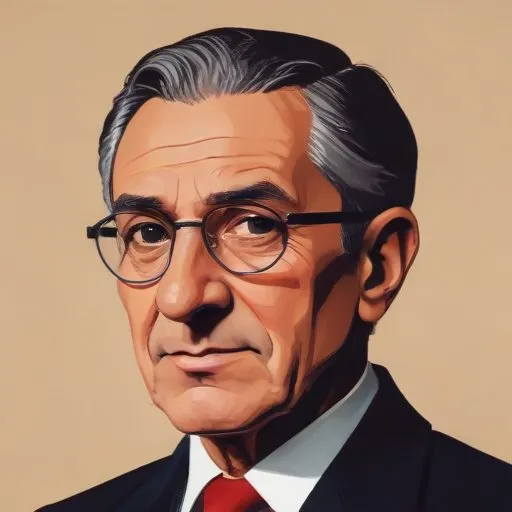
Italian professor and politician who led a campaign for electoral reform and played a key role in the transformation of Italy's political system in the 1990s.
Mario Segni is a name synonymous with electoral reform and a champion of change in Italy's political landscape. As the founder of multiple parties and a professor of civil law, Segni has left an indelible mark on Italian politics and academia.
Born on May 16, 1939, in Sassari, Sardinia, Segni was destined for greatness, being the son of Antonio Segni, a prominent politician and former President of Italy. He followed in his father's footsteps, studying law at the University of Sassari, where he later became a professor of civil law.
Segni's academic career was marked by excellence and a passion for teaching. He worked under Luigi Carraro, a four-time Christian Democrat Senator, and taught at the University of Sassari. In 1975, he became a professor of civil law and later chaired the Faculty of Law until his retirement in 2011.
A longtime member of Christian Democracy, Segni was first elected as a Regional Councillor in 1967. He later ran for the national parliament in 1976, coming second behind Francesco Cossiga, but still winning a seat. He held this office until 1996 and served as State Secretary of the Ministry of Agricultural, Food, and Forestry Policies in the second Craxi government and in the sixth Fanfani government.
Riding the momentum from the 1991 Italian electoral law referendum, which he supported, Segni contributed to the establishment of the Democratic Alliance in 1992. He also founded the Populars for Reform that same year, with the goal of changing the electoral system from proportional representation to a first-past-the-post system.
Segni's efforts for electoral reform were driven by his belief in the importance of a fair and representative democracy. He advocated for a shift from proportional representation to a first-past-the-post system, believing it would lead to greater accountability and stability in government.
Mario Segni's contributions to Italian politics and academia have left a lasting impact. His efforts for electoral reform have paved the way for a more representative democracy, and his academic career has inspired generations of students.
In conclusion, Mario Segni's remarkable career as a politician and professor of civil law has left an indelible mark on Italian politics and academia. His tireless efforts for electoral reform and his commitment to teaching have inspired generations, cementing his place as one of Italy's most respected figures.
89 Years Old
A billionaire media mogul who dominated Italian politics for decades, known for his flamboyant personality and numerous scandals.
86 Years Old
The 52nd Prime Minister of Italy, an academic and politician, led the country's government and played a key role in shaping the European Union. He's known for his economic reforms and EU integration efforts.
Born in 1919
A dominant figure in Italian politics, serving as Prime Minister seven times, known for his cunning and controversial leadership style. He was a key player in shaping Italy's post-war politics.
Born in 1922
Leader of the Italian Communist Party who implemented a policy of Eurocommunism, seeking to reform the party and distance it from Soviet influence.
98 Years Old
An Italian academic and politician who served as the 8th President of Italy, known for his role in shaping the country's politics and foreign policy during the Cold War era. He was a key figure in Italy's transition from a monarchy to a republic.
Born in 1918
The 9th President of Italy, a lawyer and politician who played a key role in shaping the country's post-war politics and served as a senator for life. He's remembered for his strong stance against organized crime and corruption.
Born in 1925
A prominent Italian journalist and politician who served as Prime Minister of Italy, known for his leadership during a tumultuous period in the country's history. He played a key role in shaping Italy's post-war politics and economy.
92 Years Old
The 45th Prime Minister of Italy, a charismatic leader who dominated Italian politics in the 1980s, known for his flamboyant style and corruption scandals. He was a key figure in European politics during the Cold War era.
